"Live The Adventure Of A Lifetime"


Island Peak Climbing
Recommended by 99.9% of travelers
Trip Code:
Peak21D
Max. Altitude:
6,160 meters (20,328 feet)
Group size:
2-14
Duration:
21 Days
Best Time for Visit:
April-June & September-November
Transportation:
private Car, jeep ,Bus & flight
Activity:
Trekking
Difficulty:
Strenuous
Accommodation:
At Hotels and Lodge or Home Stay on walks.
Region:
Everest
Arrival On:
Kathmandu
Departure From:
Kathmandu
En-Route Highlights of Island Peak Climbing
- Adventure on top striking and classic Island Peak with walk to Gokyo and Everest base camp.
- Visiting both scenic sides of Khumbu with beautiful Gokyo Lake and crossing high Cho-la pass.
- Walk into Gokyo valley within pristine glacial lakes with climb to Gokyo-Ri with amazing views.
- Enjoy panorama of worlds four highest mountains from Gokyo-Ri and Island peak summit.
- Scenic, sweeping flights to and from Kathmandu-Lukla-Kathmandu with super mountain views
- Walking into lovely cultural Sherpa villages adorned with prayer walls and spinning bells.
- Daily views of high snow capped peaks on walks to scenic Gokyo Valley and Ngozumba Glacier.
- Explore Sherpa village enriched with Buddhist religions and its interesting monasteries.
- From green alpine woodland to arctic zone of ice and glaciers at Everest base camp.
- On top scenic Kalapathar facing stunning views of high peaks of Everest at close distance.
Overview
Island Peak Climbing is one of the most popular trekking peaks in Nepal because it offers fit trekkers a clear route into Himalayan mountaineering. The climb is not as technical as major expeditions above 7,000 meters, but it is still a serious high-altitude climb that requires fitness, patience, proper gear, and a trained climbing guide.
The journey starts with a flight to Lukla and follows the classic Everest trail through Sherpa villages, suspension bridges, monasteries, high valleys, and glacier landscapes. The route passes through Sagarmatha National Park, a UNESCO World Heritage Site in the Everest region. Nepal Tourism Board notes that the park includes rugged terrain, glaciers, deep gorges, alpine landscapes, and several peaks above 6,000 meters.
What makes Lhasso Adventure’s Island Peak itinerary stronger is the 21-day acclimatization-focused route. Many Island Peak packages reach base camp faster, but this itinerary adds Gokyo, Cho La Pass, Everest Base Camp, and Kala Patthar before the climb. This helps your body adjust gradually while also giving you a complete Everest region experience.
This climb is best for trekkers who have completed high-altitude trekking before and want to try their first Himalayan summit with professional support. You do not need to be an elite climber, but you should be comfortable walking 6–8 hours a day, training before the trip, and using basic climbing gear under guide supervision.
Why Choose Lhasso Adventure for Island Peak Climbing?
Choosing the right company matters more on Island Peak than on a normal trek. The route includes high altitude, glacier terrain, fixed ropes, early-morning summit timing, and weather-based decisions. A reliable Island Peak package should focus on the full journey, not just the summit, with proper support from arrival in Nepal until the climber returns safely after the expedition.
Lhasso Adventure is a Kathmandu-based adventure company founded in 2011 with recognized connections to Nepal’s tourism and mountaineering sector, including the Nepal Tourism Department, TAAN, NMA, and HRA.
With Lhasso Adventure, this Island Peak Climbing package focuses on:
- Gradual acclimatization before the summit push.
- Local guide support throughout the Everest region.
- Climbing preparation before summit day.
- Proper route planning through Gokyo, Cho La, EBC, and Kala Patthar.
- Safety-first decisions based on weather, altitude response, and team condition.
- Travel is planned in a way that respects local culture, reduces negative impact, and helps nearby communities benefit from tourism.
Difficulty
Island Peak is known as a trekking peak, but climbers should not mistake it for a simple high-altitude walk. The route includes altitude gain, glacier sections, snow slopes, fixed ropes, and a long summit day. Top-ranking Island Peak climbing guides also highlight that climbers should not treat this peak as an easy trekking extension.
The difficulty mainly comes from five areas:
| Difficulty Factor | What It Means for Climbers |
| Altitude | The summit rises above 6,000 meters, where the oxygen level is much lower than at sea level. |
| Long walking days | Several trekking days require 5 to 8 hours of steady walking on mountain trails. |
| Summit day | The summit push can take around 10 to 12 hours depending on weather, route conditions, and team pace. |
| Technical sections | Climbers may need to use crampons, a harness, rope, a jumar, an ice axe, and abseiling techniques. |
| Weather | Strong wind, snowfall, freezing conditions, and low visibility can add extra challenges during the climb. |
Island Peak is a good choice for active trekkers who can prepare their fitness before starting the journey. Previous climbing experience is useful, but basic mountaineering techniques can be practiced with the climbing guide before summit day. Still, every climber should arrive with strong fitness, patience, good leg strength, and respect for altitude.
Altitude, Acclimatization, and Safety
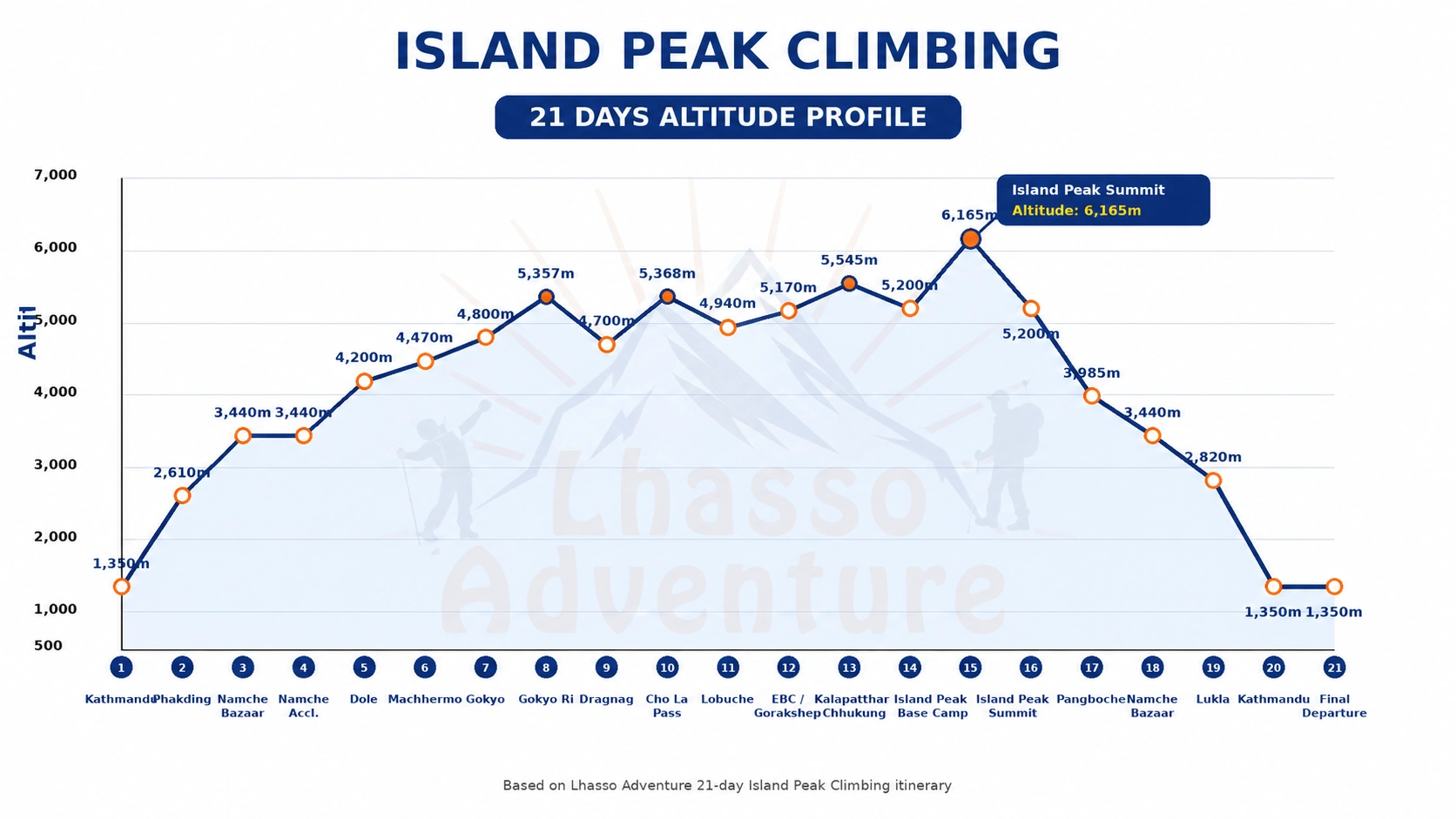
Altitude is one of the most important challenges during Island Peak Climbing. The journey moves from Kathmandu to Lukla and then gradually rises above 3,000 meters, 4,000 meters, 5,000 meters, and finally above 6,000 meters on summit day. At these heights, the body needs enough time to adjust.
Lhasso Adventure’s longer itinerary gives climbers better acclimatization support than a rushed route. Namche Bazaar, Gokyo, Cho La Pass, Everest Base Camp, Kala Patthar, and Chhukung allow the body to spend more time in the high Khumbu region before the final summit attempt.
Common altitude symptoms may include headache, poor sleep, loss of appetite, nausea, unusual tiredness, dizziness, or shortness of breath. These signs should be taken seriously. The guide monitors the team, controls the walking pace, encourages hydration, and makes safety-based decisions when symptoms appear.
For extra safety, climbers should have travel insurance that covers high-altitude trekking, peak climbing, and emergency evacuation. This is important in the Everest region because weather changes, Lukla flight delays, injury, illness, or altitude problems can affect the itinerary.
Island Peak Summit Day Experience
Island Peak summit day is the hardest part of the expedition. The climb usually begins before sunrise so the team can use better snow conditions and avoid stronger afternoon winds. Climbers start from base camp and move through rocky and snowy terrain before reaching the glacier section.
As the altitude increases, movement becomes slower and more controlled. The climbing guide manages the pace, checks equipment, and leads the team through sections where ropes, crampons, harnesses, ascenders, and ice axes may be required. In some seasons, crevasse crossings or ladder sections may also appear depending on the route condition.
The upper section can include a steep headwall and fixed-rope movement before reaching the summit ridge. From the summit, climbers can enjoy views of Lhotse, Ama Dablam, Makalu, Baruntse, and several other Himalayan peaks.
The descent is just as important as reaching the top. Many climbers become tired after the summit, so the guide manages turnaround time, descent speed, rope handling, and safe return to camp.
Detailed Itinerary Of Island Peak
On reaching Kathmandu International Airport, received by our guide and staff and then transfer to your respective hotels in the hub of Kathmandu city.
First check into your hotel rooms after getting refreshed from the flight, where our expert guides will inform regarding hotels, trekking, local lodge and overland drives with do’s and dont’s information.
After an early morning flight from Kathmandu to Lukla, which takes around 35 minutes, you’ll embark on a short and gradual hike to Phakding, typically taking 3-4 hours of trekking.
Trekking Distance :
9 kilometersTrekking Duration :
3-4 hoursElevation Gain :
1350m/4429.134ft.Elevation Loss :
190 meters (623 feet)
Today walk leads to famous Namche Bazaar where altitude gains as walk progress, morning walk starts following the river and crossing several times to reach at Monjo village near Sagarmatha National Park entrance, from here walking on river valley and gorge covered within nice woodland of tall rhododendron-pines and fir trees.
After crossing a high last bridge with few hours climb to Namche Bazaar with stunning views of Everest-Lhotse and Kongde peaks.
Namche Bazaar at 3,440 m high an ideal place for rest day to acclimatize, the main town / village of Khumbu where colorful and exciting Saturday market takes place once a week.
Trekking Distance :
11 kilometersTrekking Duration :
6-7 HoursElevation Gain :
830 meters (2,723 feet)
Rest day for acclimatization before heading higher terrain, morning after breakfast with options for hike to Everest View Hotel or walk on top of Namche, where you can catch super landscapes scenery with Mt. Everest, Lhotse, Amadablam with series of high peaks, here enjoy visiting National Park Museum provides you with much information of Khumbu region, Sherpa history-culture-flora and fauna including detail on mountaineering.
From Namche Bazaar walk leads on gradual scenic path with uphill to reach at Mong Hill with few houses serving as Tea-House and Lodge with fantastic views of peaks, from here downhill to Phortse Tenga near Dudh Kosi within forested area.
With possible lunch stop, afternoon walk leads to a climb into rhododendron, pines, fir forest with grand views of snow-capped peaks.
After few hours climb reaching at Dole at 4,200 m high a moderate size settlement with good lodges to stay.
Trekking Distance :
11 kilometersTrekking Duration :
5-7 HoursElevation Gain :
760 meters (2,493 feet).
After Dole, walk on high trail for an hour to Lhabarma Kharka at 4,325 m and Luza at 4,390m; then skirting around a ridge with views of Machherm0, situated below on a small valley, walk downhill to Machherma for lunch and overnight stop.
Here after lunch rest of the afternoon free for acclimatization and short hike with views of Mt. Cho Oyo 8,210m and other mountains flanking above Ngozumba Glacier.
Trekking Distance :
6 kilometersTrekking Duration :
3-4Elevation Gain :
270 meters (886 feet)
Morning walk leads to Gokyo Lake following a scenic trail to Pangka 4,545m, then climb on rocky path into ablation valley passing first lake and then second lakes, to reach a third lake called Dudh Pokhari or Gokyo Lake.
This beautiful area within Gokyo at 4,800 meters high, after lunch short walk around lake with views of Mt. Cho Oyo world’s 06th highest and Gyachung Kang that reflects on emerald Gokyo Lake.
Trekking Distance :
7 kilometersTrekking Duration :
4-5 HoursElevation Gain :
330 meters (1,083 feet)
Free day at scenic Gokyo valley and its beautiful glacial lakes, where morning climb of few hours leads you to the highest point of the adventure on top Gokyo Ri at 5,357 m high, offering tremendous panorama from Mt. Cho-Oyu, Mt. Everest, Lhotse and of Mt. Makalu covering four world highest mountains at one glance with series of smaller peaks.
Enjoying views of grand peaks with massive Ngozumba Glacier and then down to Gokyo for lunch with rest of the afternoon at leisure.
Trekking Distance :
4 kilometersTrekking Duration :
4-5 HoursElevation Gain :
557 meters (1,827 feet)
Morning at leisure marvel breathtaking views of high snow capped peaks with Cho-Oyu that straddles the border with Tibet and Nepal.
After breakfast slowly walk towards Cho-la pass base at Thaknag, a short day as walk heads back to second and first lake close to Ngozumba Glacier moraine, as journey continues to the bottom of Cho-La Pass also called as Tsho-la a small settlement with few lodges.
Trekking Distance :
5 kilometersTrekking Duration :
3-4Elevation Loss :
100 meters (328 feet)
Starting early morning before crack of dawn heading for a long steep climb to reach at the top of Cho-la pass (pronounced as Tsho-la), over rocky moraine in snow condition this will be tough to find the right path in snow and ice, walking on rubble of moraine reaching at the top enclosed by Cholatse, Nirekha and Taboche peaks, after a hard climb to the top, descend with care to a small valley at Dzong-la for overnight halt where few lodges available overlooking close Cholatse and Taboche peaks.
Trekking Distance :
8 kilometersTrekking Duration :
7-8Elevation Gain :
720 meters (2,362 feet)Elevation Loss :
590 meters (1,937 feet)
After pleasant overnight at Dzongla, morning walks leads to a short uphill climb and then on gradual path above Thugla (Dugla), located on the midway of Pheriche and Dingboche on route Everest Base Camp and Lobuche. From here a slow good walk to Lobuche for overnight stop.
Trekking Distance :
6 kilometersTrekking Duration :
5-6 HoursElevation Gain :
110 meters (361 feet)
From Lobuche walk heads closer towards Everest Base Camp, where morning leads to gentle uphill with short steep climb in between glacier and moraine reaching at Gorakshep.
Gorakshep located beneath Mt. Pumori and Kalapathar view point hill, after a brief refreshing stop at Gorakshep, this was an early Everest base camp till mid 1980’. From here walk continues towards east at Everest Base Camp, where route leads over moraine and glaciers then finally reaching on the foot of Everest at base camp.
Enjoy glorious views of massive Khumbu Ice Fall and glaciers, after completing an adventure of a lifetime experience walk back to Gorakshep for overnight halt.
Trekking Distance :
16 kilometersTrekking Duration :
7-9 HoursElevation Gain :
424 meters (1,391 feet)Elevation Loss :
200 meters (656 feet)
Morning climb on top Kalapatthar at 5,545 m, highest spot on treks offers panorama of mountains with Everest at stone throw distance.
With amazing time on top head back to Gorakshep for breakfast and continue trek downhill past Lobuche and Thugla, where walk leads on good scenic trail towards Imjatse valley to reach at Chhukung a small settlement with few good lodges for overnight stop before Island Peak climb.
Trekking Distance :
18 kilometersTrekking Duration :
6-7 HoursElevation Loss :
815 meters (2,674 feet)
Morning from Chukung an early start to reach at high Imjatse valley where route leads to Parsya Gyab close to Island Peak, after a steep climb heading south over moraine and left of Lhotse glacier, following glacial streams to the snout of Imjatse glacier crossing a dry lake between Lhotse and Imja glaciers to reach at island Peak base camp, afternoon free to relax and preparation for the climb.
Trekking Distance :
6 kilometersTrekking Duration :
3-4 hoursElevation Gain :
470 meters (1,540 feet)
From base camp, heading further high up towards Island peak on our final day as well the highlight of the adventure, with final preparations heading for the climb before crack of dawn to reach across a broad and open gully, and then follow snow-covered glacier above, avoiding serac and crevasses climbing northwards over snow covered scree in the margin in between a glacier and base of the main top ridge.
Then climb leads to cross a gully with some stone and icefall danger, a steep snow and ice ramp leads upwards for nearly 100 meters (300ft) to the top of the summit, on reaching the topwith high spirit and triumph overlooking panorama of world’s highest mountains Mt. Everest 8,848 m, Lhotse 8,501 m, Mt. Amadablam 6,856 m, Mt. Makalu 8, 463 m, Chamlang and Baruntse peaks in the far distance, after an experience of a life time descend on the same route towards base camp.
Trekking Duration :
10 - 12 hoursElevation Gain :
1195m/3920.604ft.
We have taken extra care for this classic climb, where Himalayan bad weather might obstructs with our programs and schedule itinerary days. To be safe an extra contingency or reserve day to accommodate the safe climb if weather is a problem. Where with extra day will help and support to achieve successful climb on top Island Peak.
If all goes well this spare day to be used with easy walk on route to Namche and Lukla with more day in between making the day walks a short.
After the challenging climbs of Island Peaks, we begin our descent to lower elevations. The trail follows an easy downhill path through alpine meadows and yak pastures. We pass through Dingboche, a major stop on the Everest Base Camp trek, before continuing towards Pangboche. This village is home to one of the oldest monasteries in the region, said to house a sacred relic of a Yeti scalp. We take some time to explore the monastery before settling into our teahouse for the night. Overnight in Pangboche.
Trekking Distance :
11 kmTrekking Duration :
6-7 Hours
Descending further, we re-enter lush forests of rhododendron and pine, enjoying views of Ama Dablam, Everest, and other surrounding peaks. We pass through Tengboche, famous for its iconic monastery, where we can stop for a short visit and soak in the spiritual atmosphere. From here, we make our way to Namche Bazaar, the vibrant hub of the Khumbu region. After days in remote high-altitude areas, Namche feels lively with its bakeries, shops, and cafés. Overnight in Namche Bazaar.
Trekking Distance :
13 kmTrekking Duration :
6-7 Hours
Our last day walk of the adventure where trek follows on the same trail back to Lukla past Monjo, Phakding and Ghat villages crossing few times over Dudh Kosi, with last final climb to reach Lukla town for last overnight stop around high scenic Khumbu and Everest region.
Trekking Distance :
18 KmTrekking Duration :
7-8 Hours
Morning transfer to Lukla Tenzing and Hillary airport for sweeping short flight to Kathmandu facing scenic views of mountains, green scenery of hills and farm fields with nice villages and towns as flight lands at Kathmandu airport and then back to your hotel, with free afternoon to relax of great memorable adventure on top Island Peak Climb with Gokyo Valley and Everest Base Camp.
Elevation Loss :
1510m/4954.0682ft.Fly Time :
35 min
After breakfast, you’ll have some free time to explore Kathmandu before being transferred to Tribhuvan International Airport. Our team will assist with check-in and bid you a fond farewell. As you leave, the memories of Island Peak and the majestic Himalayas will stay with you, and the mountains will always be waiting for your return. Safe travels, and we look forward to welcoming you back for your next adventure with Lhasso Adventure!
Cost Includes
Cost Excludes
Equipment & Packing List
Having the right equipment ensures your safety and preparedness for a variety of scenarios, not to mention that it makes trekking more pleasurable. All hikers, regardless of experience level, need to purchase and learn how to use quality equipment. Depending on the amount of preparation and gear employed, a fun trip can turn into a challenging ordeal. Please choose the required equipment from the list below.
Personal Climbing Equipment
- Climbing Harness
- Climbing Helmet
- Climbing Boots
- Crampons
- Ice Axe
- Carabiners
- Ascenders/Descenders: Mechanical devices for ascending and descending ropes.
- Rope
- Snow Barrels/Adjustable Snow Anchors
- Sling/Runners
- Ice Screws
Clothing
- Base Layers
- Insulating Layers
- Outer Layers
- Gloves
- Hats and Balaclavas
- Socks
Camping Gear
- Sleeping Bag
- Sleeping Pad
- Backpack
- Daypack
- Dry bags
Other Essential Gear
- Headlamp
- Sunglasses/Goggles
- Trekking Poles
- First Aid Kit
- Navigation Tools
Provided by Lhasso Adventure
- Group Climbing Gear: Ropes, tents, cooking equipment, and other group gear necessary for the climb.
Map
If you have any more specific questions or need further details, please feel free to contact us anytime.
Contact UsTraveler's Review
Trip Reviews
FAQ's for Island Peak Climbing
Island Peak, also known as Imja Tse, is a popular trekking peak in the Everest region of Nepal. It stands at an elevation of 6,189 meters (20,305 feet) and is often climbed as a first Himalayan peak by many trekkers.
The peak was named Island Peak by Eric Shipton's party in 1952 because it appears as an island in a sea of ice when viewed from Dingboche.
While previous climbing experience is beneficial, it is not mandatory. Basic mountaineering training, including skills like using crampons, ice axe, and ropes, is usually provided as part of the expedition.
Physical fitness is crucial. Cardiovascular training, strength training, and some hiking with a loaded backpack will help prepare you. It is also advisable to have experience with high-altitude trekking.
Essential gear includes climbing boots, crampons, an ice axe, a harness, a helmet, and appropriate clothing for high-altitude conditions. Additionally, our team will provide you with a detailed gear list.
The entire expedition typically takes about 18-20 days, including acclimatization days and contingency days for bad weather.
The best times to climb Island Peak are during the pre-monsoon (March to May) and post-monsoon (September to November) seasons.
The main risks include altitude sickness, weather-related challenges, and climbing-related accidents. Proper acclimatization, physical preparation, and following the guide's instructions minimize these risks.
we provide experienced guides, proper acclimatization schedules, medical kits, and communication equipment. Some also include emergency evacuation services.
Yes, travel insurance that covers high-altitude trekking and climbing, including emergency evacuation, is mandatory for Island Peak Climbing.
You need a climbing permit from the Nepal Mountaineering Association (NMA), a Sagarmatha National Park entry permit, and a TIMS (Trekkers' Information Management System) card.
The cost can vary depending on the services included, and the season. covering permits, guides, accommodation, meals, and domestic flights.
Accommodation ranges from teahouses/lodges during the trek to tents at Island Peak Base Camp.
During the trek, teahouses offer a variety of meals, including Nepali, Tibetan, Indian, and Continental dishes. At base camp, meals are prepared by the expedition team, focusing on high-energy and nutritious food suitable for high-altitude conditions.
Island Peak is considered a moderate to difficult climb, requiring basic mountaineering skills and good physical fitness. The summit day involves climbing steep snow and ice slopes and crossing crevasses.
Yes, climbing gear can be rented in Kathmandu and Namche Bazaar. However, it's advisable to bring your own gear for comfort and reliability.
Mobile network coverage is available in most parts of the Everest region, though it can be unreliable at higher altitudes and in remote areas. Some expeditions provide satellite phones for emergency communication.
Subscribe & updates
Associated with


