



Chandra Bahadur Rai
- Adventure Consultant and Trip leader
"Live The Adventure Of A Lifetime"
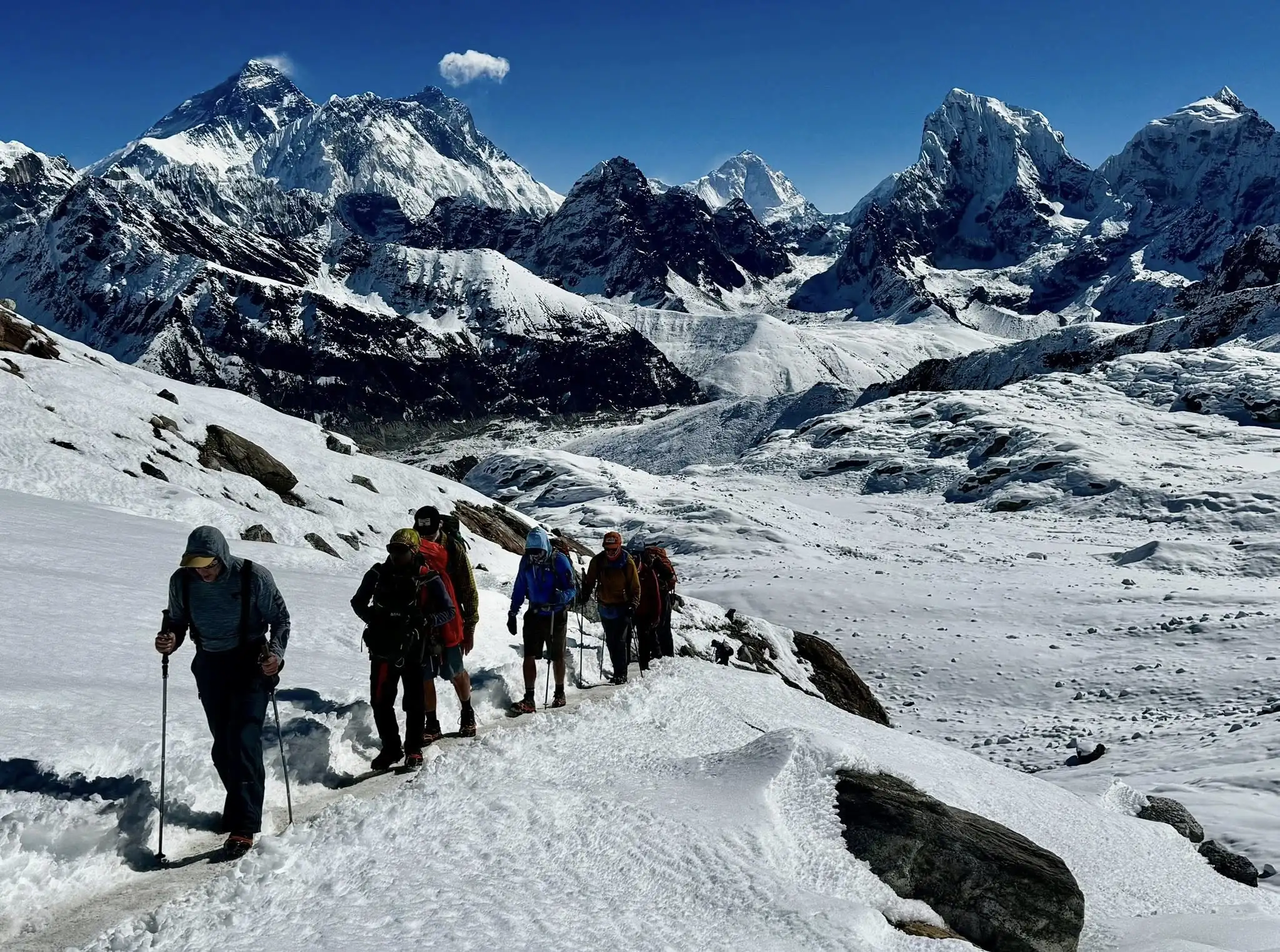
For trekkers who want to experience everything the Everest region has to offer, the Everest Three Passes Trek is widely considered the ultimate Himalayan adventure. Rather than following a single trail to Everest Base Camp and returning the same way, this route forms a complete circuit through the Khumbu region, connecting remote valleys, high mountain passes, traditional Sherpa settlements, and some of Nepal’s most spectacular viewpoints. It is a demanding trek, but one that rewards every step with constantly changing landscapes and unforgettable mountain scenery.
Unlike shorter Everest treks, every stage of this journey offers something different. The trail winds through quiet forests, glacier-fed rivers, alpine valleys, and rugged mountain terrain before crossing the three famous Himalayan passes—Kongma La 5,535 m, Cho La 5,420 m, and Renjo La 5,360 m. Each pass presents a new side of the Everest region, making the journey feel like several different treks combined into one continuous adventure.
The route also includes many of the Everest region’s best-known highlights. Trekkers reach Everest Base Camp 5,364 m and climb Kala Patthar 5,545 m. for close-up views of Mount Everest, while the western section of the circuit passes through the peaceful Gokyo Valley and its beautiful chain of turquoise glacial lakes. For those interested in exploring these destinations individually, sections of this route follow both the Everest Base Camp Trek and the Gokyo Lake Trek, before continuing into quieter areas that many visitors never experience.
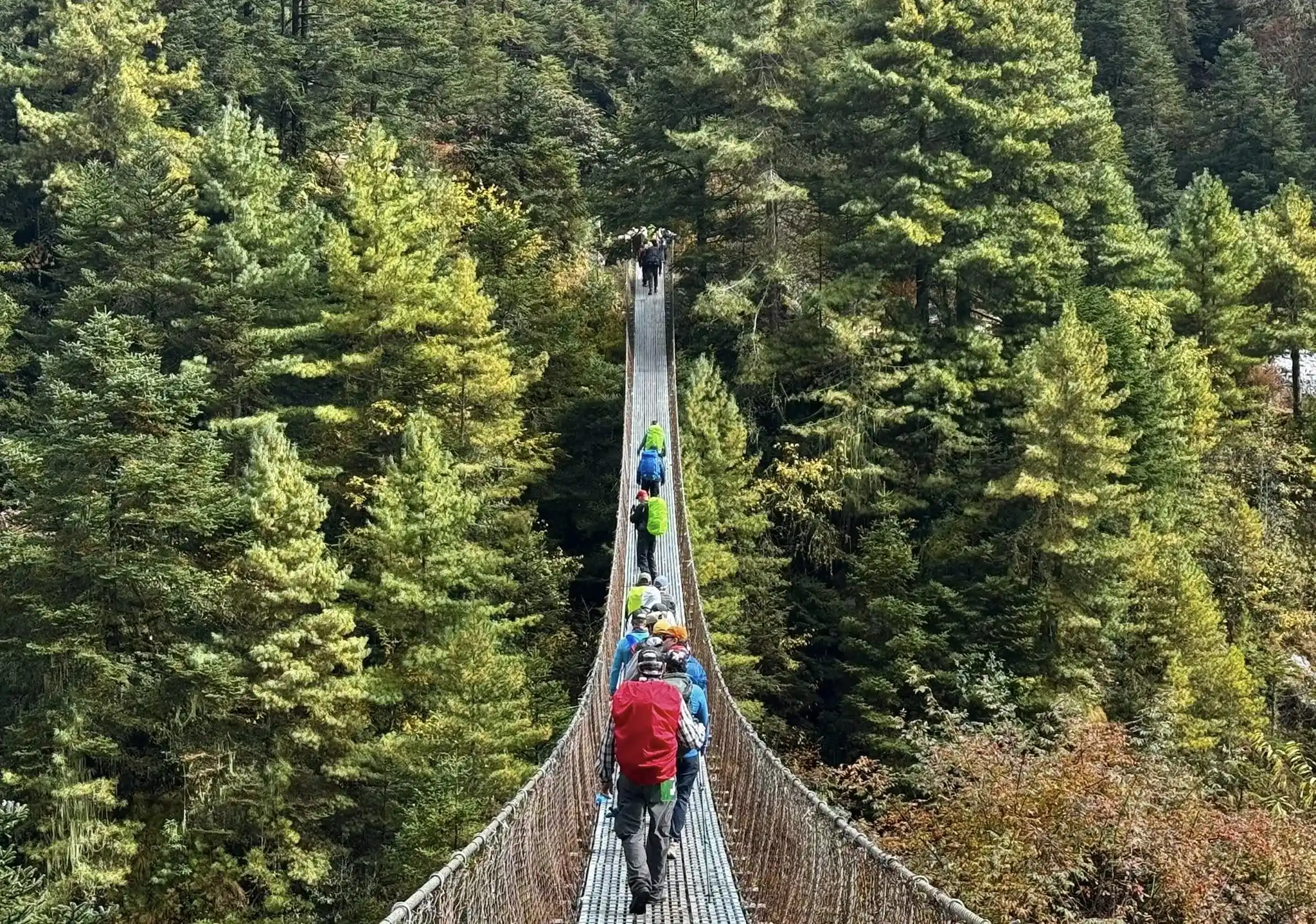
Beyond the famous viewpoints, the trek provides a deeper connection with the Khumbu region. You’ll spend time in welcoming Sherpa villages, visit centuries-old Buddhist monasteries, cross long suspension bridges, and stay in traditional mountain teahouses where daily life has remained closely connected to the Himalayas for generations. These cultural experiences are just as memorable as the mountain landscapes themselves.
The Everest Three Passes Trek is best suited for experienced trekkers who are comfortable with long walking days and high-altitude conditions. For those prepared for the challenge, it offers the most complete way to explore the Everest region, combining world-famous landmarks with quieter trails, diverse scenery, and experiences that go far beyond the classic Everest Base Camp route.
Upon arrival at Kathmandu’s Tribhuvan International Airport (1,350m), Lhasso Adventure representative will warmly welcome you and transfer you to your hotel. After check-in, take some time to rest, freshen up, and enjoy a meal. In the evening, our guides will provide a briefing on the journey ahead, followed by team introductions and discussions. Later, we’ll head out for a welcome dinner at a local restaurant to experience authentic Nepali cuisine.
After breakfast we begin our tour of four amazing UNESCO World Heritage Sites. These include the architecturally rich Durbar Square, the sacred Hindu temple of Pashupati Nath, the interesting ‘Monkey Temple’ (Swayambunath) and Bauddha Nath Stupa which is one of the largest stupas in the world.
All treks to Everest begin from Luka where we will be flying to early in the morning, right after breakfast. The flight will be an interesting one since we will be flying amidst the grand Himalayas in a Twin Otter airplane. We begin our short trek to Phakding immediately after landing. At one hour’s gradual descent, we will be at a Cheplung village from where we have a glimpse of Mt. Khumbila (18900ft), a sacred mountain which has never been climbed. From Cheplung, we continue descending to Phakding and spend the night.
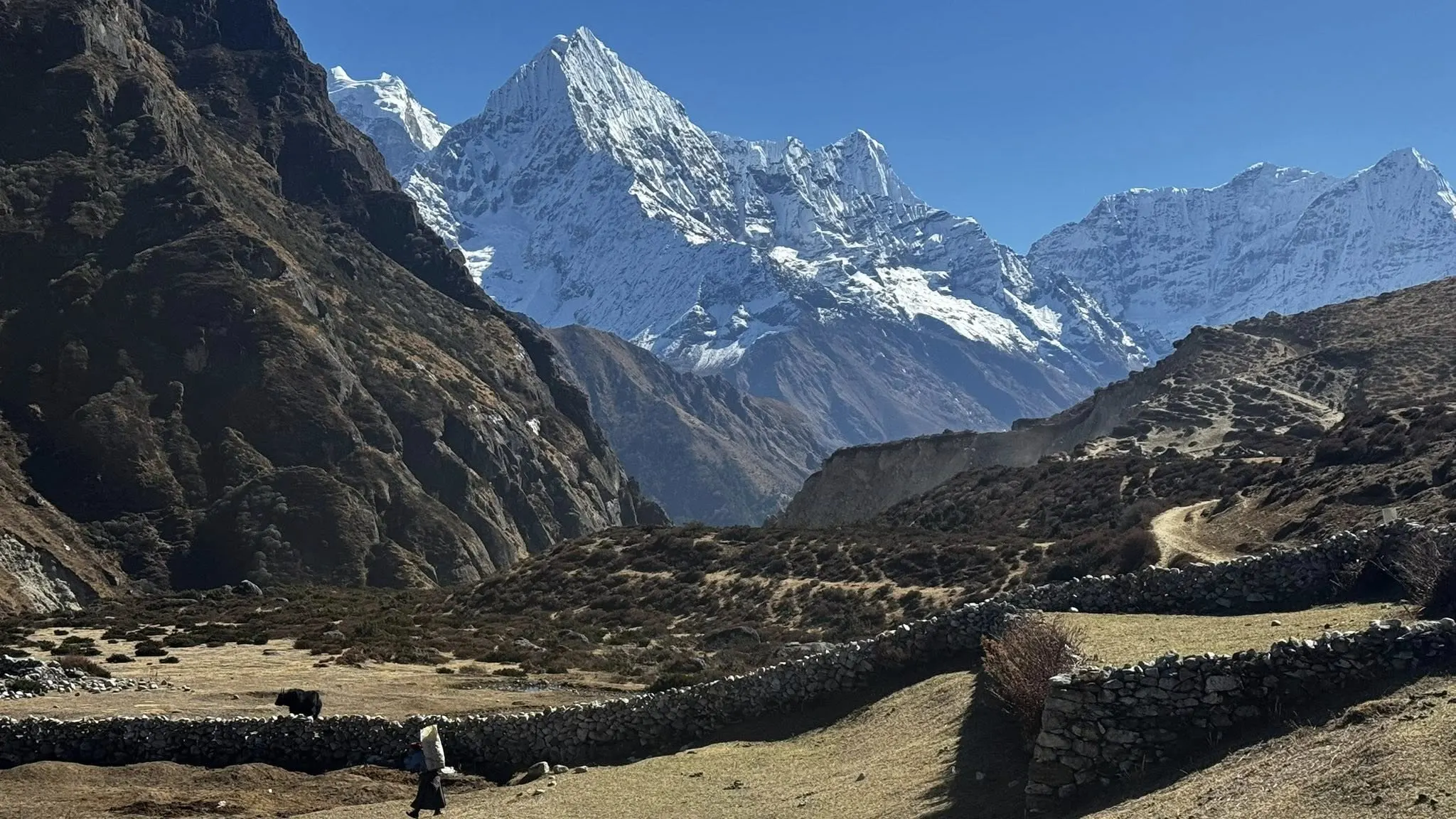
We begin our trek on uphill and downhill trails with multiple crossings over Dudh Koshi River and a magnificent view of Mt. Thamserku (21,675ft) from the Benkar village. We cross more bridges and reach the entrance of Sagarmatha National Park at Monjo, where our trekking permits are checked. We walk furthermore and pass through Jorsale village before reaching Namche Bazaar. From here, we get beautiful views of the Himalayas including Everest, Lhotse, Tawache and others. Overnight in Namche Bazaar.
This is the first of the three scheduled rest days which will help us acclimatize to the high altitude. Since experts believe that it is better to stay active even during rest days for better trekking experience we are going to spend the day enjoying small hikes in and around Namche Bazaar. We hike up to Everest View Hotel to enjoy admirable views of the Himalayan vista. On our way back to Namche we also tour the Khumjung Monastery (houses a yeti scalp!) and Hillary School. Our guide can also take us to the Tourist Visitor Center near the headquarter of the Sagarmatha National Park where we can observe an assortment of things related to the first Everest ascenders, Sherpa culture and learn about the various plant and animal life in the Everest region. Overnight in Namche Bazaar.
We begin today’s trek on an easy trail to Phunki Thanga. From here we ascend towards Tengboche village which is home to the largest monastery in the Everest region. The monastery is located within the Sagarmatha National Park and provides panoramic views of the highest mountains on earth including Everest, Ama Dablam, Thamserku, Nuptse and Lhotse. We try to reach the monastery by 3:00 in the afternoon and may even be able to witness a religious Buddhist ceremony. Overnight in Tengboche.
We begin today’s trek by walking downhill and pass through lush forests filled with birch, conifers and rhododendron trees. We continue our trek with views of Mt. Everest, Lhotse and Ama Dablam to keep us company. The picturesque trail dips down to Debuche, crosses the Imja River and takes us to Pangboche. While walking the upper Pangboche trails, we get a more pristine view of the Himalayas and Pangboche Monastery. We move ahead towards the Imja Valley, Lobuche River and ultimately climb up to Dingboche. The village is a beautiful windy settlement overlooked by chortens and prayer flags. Overnight in Dingboche.
The trek from Dingboche to Chhukung is a short but scenic journey, taking you through a beautiful valley with views of towering peaks like Ama Dablam, Lhotse, and Island Peak. As you ascend, the landscape becomes more rugged, with alpine meadows and scattered stone huts. Chhukung, a small village nestled at 4,730 meters, offers stunning panoramic views and serves as a perfect base for acclimatization before heading toward the Island Peak or further into the high Himalayas.
Our trail passes through stone-walled fields and Imja Khola valley before entering glacier moraines amidst towering Himalayas. The trail continues to Bibre which is a yak herdsman place. From here, directly across the valley is the fantastic Ama Dablam and the Amphu Labsa mountains. The trail ahead is intersected by icy streams. We continue our walk for around half an hour and reach Chhukung. After lunch, we begin our trek towards Chhukung Ri. The climb to Chhukung Ri involves some easy scrambling near the summit. From the top, we can look directly across the valley for a fantastic view of Ama Dablam and Amphu Labcha peaks. We descend back to Chhukung to spend the night.
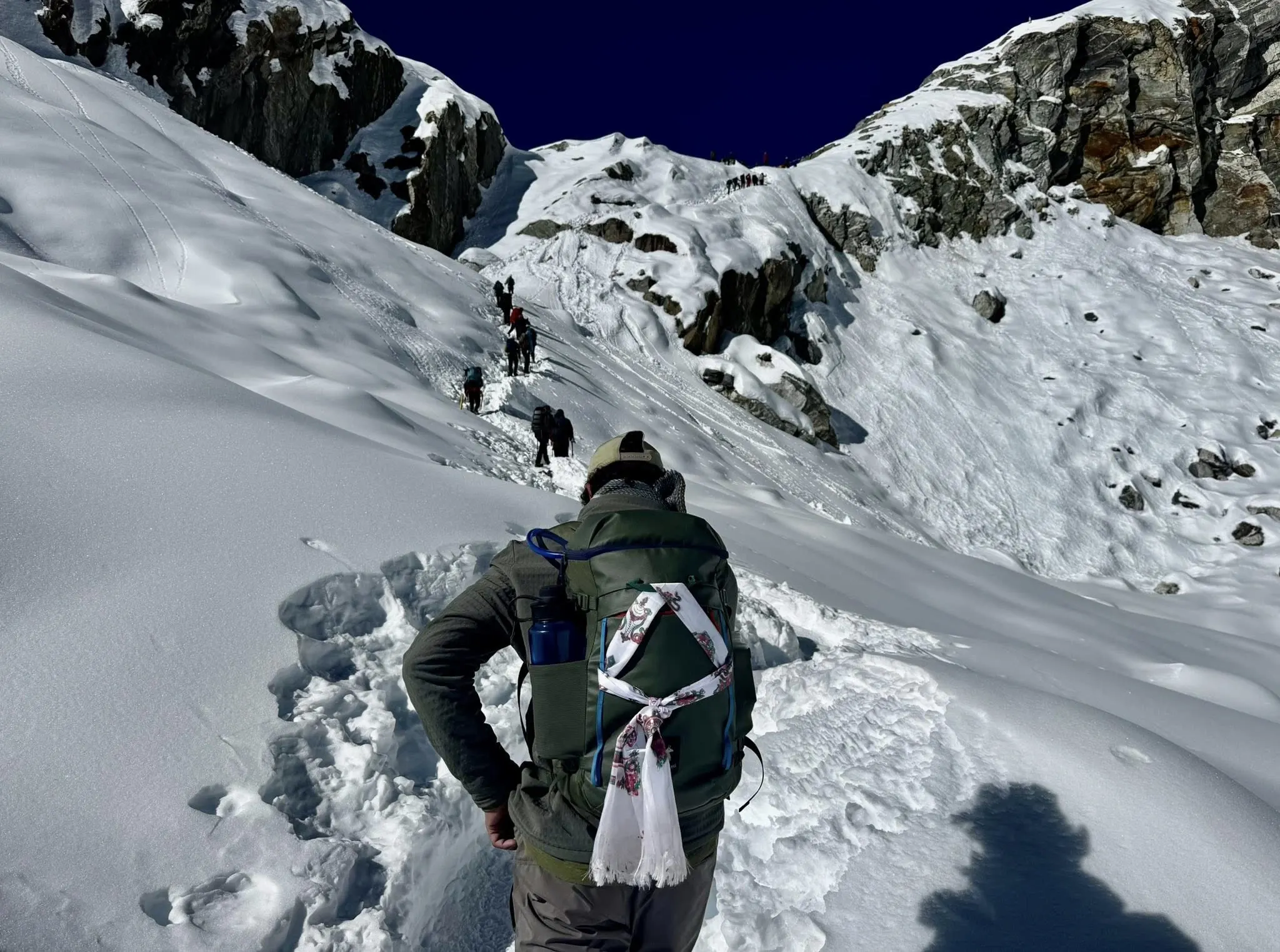
We begin today’s trek very early in the morning to reach the highest part of the entire trip which is Kongma La pass. We can either take a trail over a hill which is to the northwest of Chhukung over the Nuptse Glacier moraines or we can walk back to Bibre and trek on the trail above the Niyang Khola. The top of the pass is marked by cairns and Buddhist prayer flags. The final descent from the pass is the most difficult part of today’s journey. After climbing the moraine on the far side, the trail turns north through Khumbu Glacier which takes us to Lobuche. Overnight at Lobuche.
Note:Trekking through Kongma La is optional. If we do not want to tackle the strenuous Kongma La pass today and want to go directly to Lobuche from Chhukung, we can do that too.
Our trail moves along the lateral moraine of the Khumbu Glacier. Ahead on the trail we see the crest of the north ridge of Everest along with Pumori, Mahalangur, Lingtern, Khumbutse, Nuptse and other mountains. A small ascent takes us to Thangma Riju. From here we admire panoramic views of the Himalayan vista. We ascend on a steep trail up to the top of Changri Glacier. As we reach Gorak Shep, we are surrounded by the Himalayas. After resting for a short while, we continue to Everest Base Camp. We pass through rocky dunes, moraines and streams before reaching the base camp of the world’s tallest mountain, Everest. From here we admire Nuptse, Khumbuste and Pumori mountains. We trek back to Gorak Shep and spend the night.
Alternatively, we can visit Kala Patthar today instead of the next day as many believe that the sunset view from Kala Patthar is more stunning than the sunrise view.
We start our trek to Kala Patthar early in the morning in order to catch remarkable views of the first light of the sun shining on Mt. Everest. However, we need to be prepared for trekking in the dark and cold temperature (the temperature varies according to the season). Furthermore, there is always a chance for chilly winds which are quite common. As we continue our trek, familiar peaks such as Lingtren, Khumbutse, Changtse, Everest and Nuptse tower above us. After several hours of ascent, we will be on the top of Kala Patthar. The close-up view of Mt. Everest and other Himalayan peaks from Kalapathar is amazing. We enjoy the stunning Himalayan vista and descend to Lobuche where we stay the night.
Those participants who will visit Everest Base Camp today will have an early breakfast to start early as Everest base camp hike takes longer than the hike to Kala Patthar. After returning to Gorak Shep, both the groups will have lunch together.
From Lobuche we trek downhill on a trail alongside the Khumbu Glacier. Our trail splits into two and we choose the trail on our right. On the way we can better admire the view of the looming Awi Peak. We pass through a stupa and tombstones in the distance. After walking for a while we begin to ascend. During the ascent, we see Chola Tsho Lake nearby. We continue further and pass another lake which is lot smaller than the Chola Tsho Lake. We cross the Chola Khola on a bridge before reaching Dzongla. Overnight in Dzongla.
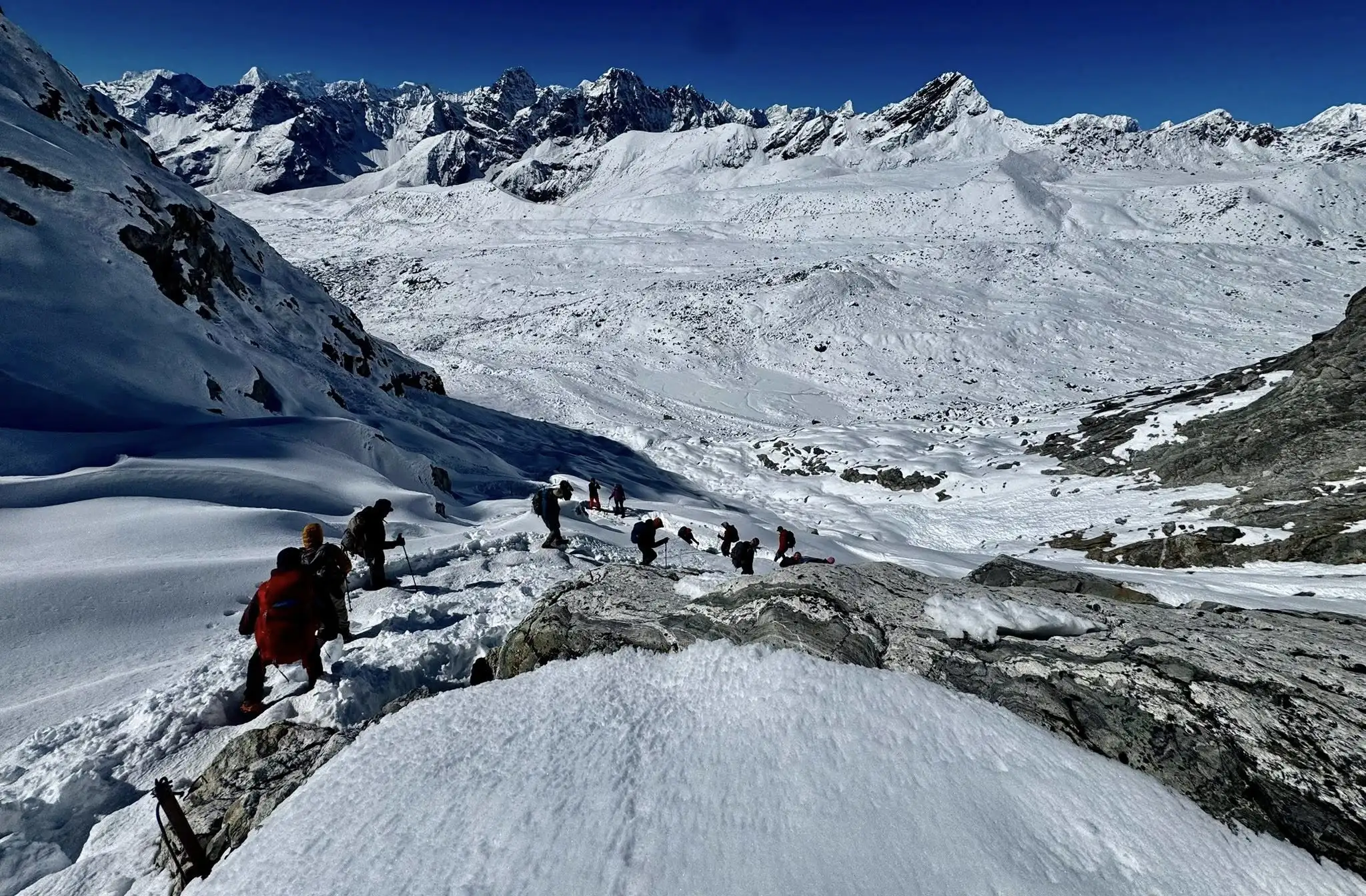
As we gain height, the Cho La Lake begins to appear and the Ama Dablam presides over a range of mountains on the south and Cholatse soars on the west. Climbing the incline is not easy; it is steep, but made worse by boulders over some of which we will have to scramble. The final climb to the Cho La can be a little tricky as the trail curves round a crevasse. The top of the pass is marked by prayer flags and cairns. Scenery of majestic peaks on all directions is breathtaking. Although long, the path leading down to Thangnak is not difficult. Our trail brings us to the edge of the Ngozumpa glacier, which is the longest glacier in Nepal. Reaching the other side of the glacier, we see the second Gokyo Lake on the series of six lakes. A short distance away is the third Gokyo Lake. On the edge of this lake stands the Gokyo Village where we spend the night.
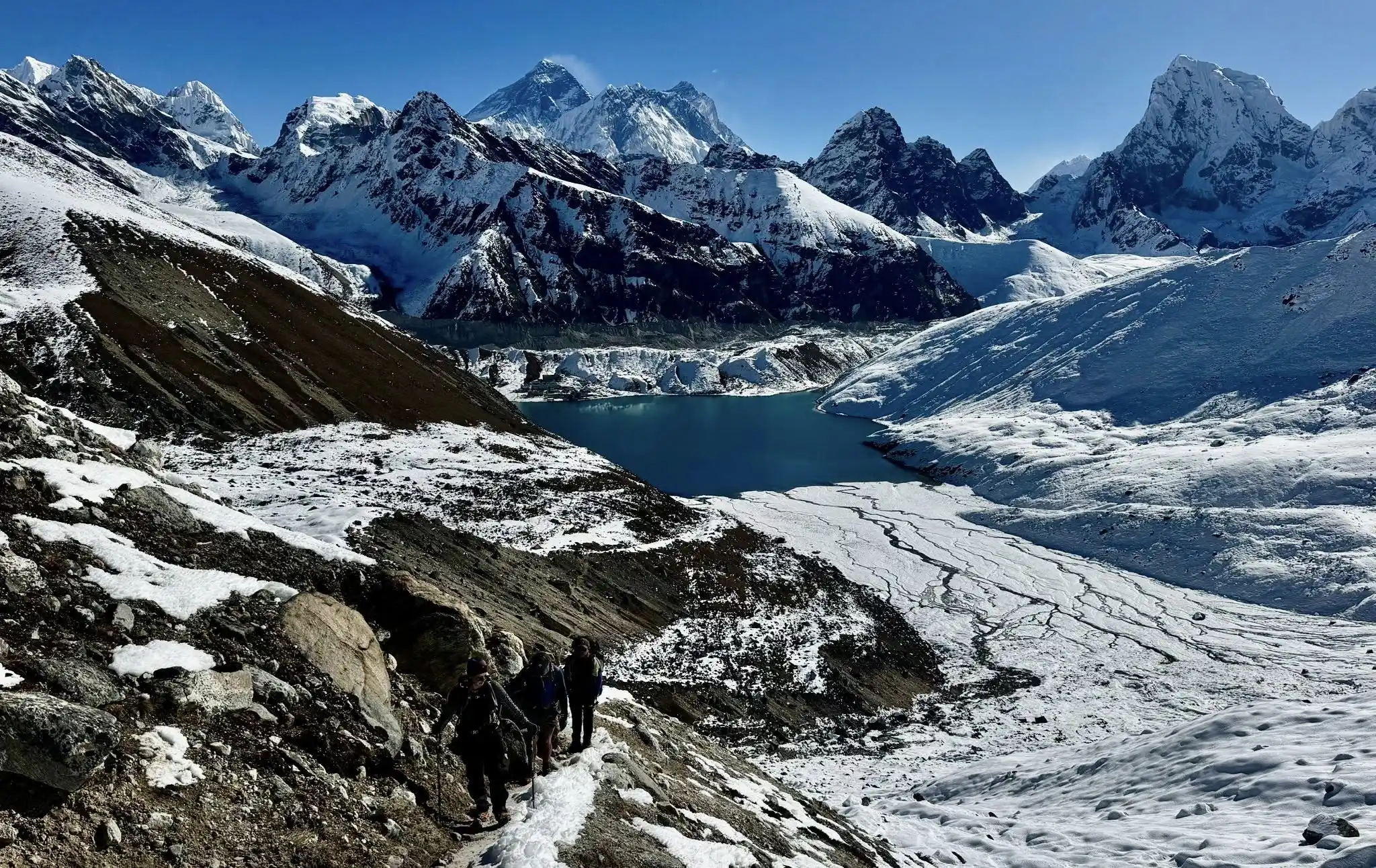
We climb Gokyo Ri today and enjoy views of the incredible mountain vista. We can also tour the fourth Gokyo Lake today which is only 3km north of the Gokyo Village. Next, continue trekking to the 5th lake. The view from ‘Scoundrel’s Viewpoint’, located at the edge of the 5th lake, is astonishing. Cho-Oyu, Gyachung Kang, Everest, Lhotse, Nuptse, and Makulu mountains and the huge Ngozumba Glacier are ours to admire. We trek back to Gokyo and spend the night.
We start the day early in the morning to complete the long day’s trek ahead. Our trail moves alongside Dudh Pokhari (lake) for a while. We walk for around two hours before descending towards the Renjo La pass. On the way we are rewarded with extravagant views of the Himalayan and Rolwaling ranges and others. Views from the Renjo La pass are much like that from Gokyo Ri with the third Gokyo Lake and Gokyo Village beneath the gray smear of the Ngozumpa Glacier. We also get outstanding views of Mt. Everest from the top of the pass. Continuing on from the pass, our trail winds down a stone staircase and then moves over a loose scree to reach the south bank of Angladumba Tsho Lake. The prescence of ice on the trail while descending down can make our descent a bit hazardous. Along the way we see Relama Tsho and Renjo Lake. We walk down a narrow valley clogged with giant boulders to Lungden where we stay overnight.
The descent from Lungden to Thame follows a traditional route used for centuries by the Tibetan traders. We cross the Bhote Koshi River and descend to Taranga. The trail continues to descend and we cross two bridges before reaching Thame. Overlooking Thame is its famous Gompa situated on a hill to the west. From here, we descend gradually on a trail that passes through a few small villages before reaching Namche Bazaar which is probably the biggest town in the Everest region. Overnight in Namche Bazaar.
We begin our trek with a descent. As we continue our trek, we cross several bridges over the fast flowing Dudh Koshi River and its tributaries. Now the trail has become more level and natural. On our trek we enjoy walking on open plains, through rhododendron and pine forests and enjoy distant views of the snow covered peaks. We walk through Sherpa villages noticing their impressive faith in Buddhism and the culture of prayer stones and prayer flags. After reaching Lukla, we stretch those sore legs and recall the experiences of the last couple of weeks. Our long trek to the mountain and its high passes ends today. Overnight in Lukla.
Morning transfer to Lukla, Tenzing and Hillary airport for sweeping short flight to Kathmandu facing scenic views of mountains, green scenery of hills and farm fields with nice villages and towns as flight lands at Kathmandu airport and then back to your hotel, with free afternoon to relax of great memorable adventure on Everest Three Passes Trekking.
Our amazing journey in the Everest region including that to the base camp of Mt. Everest and crossing high passes comes to an end today. A company representative will pick you up from you hotel and drop you off at the airport 3 hours before our scheduled flight.
Our standard itinerary may vary slightly due to weather, trail conditions, government regulations, or individual health needs. In all cases, Lhasso Adventure guides evaluate the situation and find the best safe alternative. We recommend arriving in Kathmandu at least one day before the trek start date, and booking international flights with 2–3 buffer days after your return date.
At Lhasso Adventure, we believe travel should create a positive impact. That’s why we donate 10% of our profits to the Mother and Children Art Foundation (MCAF), supporting education, healthcare, and sustainable opportunities for underprivileged women and children across Nepal.
Through our partnership with MCAF, we also support community initiatives, including medical health camps, school volunteering programs, and projects that improve the well-being of local mountain communities. Every trek with us helps give back to the people who make Nepal truly special.
Lhasso Adventure holds active membership with Nepal’s leading trekking bodies and enforces strict responsible tourism standards on every departure.


All Lhasso Adventure group departures for the Everest Three Pass Trek have a maximum of 16 participants. Small groups mean a more personal experience, better acclimatization monitoring, and less impact on the trail. Can't find a date that works? We also offer private departures on any date,
| Start | Finish | Availability | Price | |
|---|---|---|---|---|
| 01/10/2026 | 20/10/2026 | Trip Status available | Starting from $ 2278 | Book Now |
| 17/10/2026 | 05/11/2026 | Trip Status available | Starting from $ 2278 | Book Now |
| 09/11/2026 | 28/11/2026 | Trip Status available | Starting from $ 2278 | Book Now |
| 20/11/2026 | 10/12/2026 | Trip Status available | Starting from $ 2278 | Book Now |
| 02/12/2026 | 21/12/2026 | Trip Status available | Starting from $ 2278 | Book Now |
| 10/12/2026 | 29/12/2026 | Trip Status available | Starting from $ 2278 | Book Now |
| 15/01/2027 | 03/02/2027 | Trip Status available | Starting from $ 2278 | Book Now |
| 25/01/2027 | 14/02/2027 | Trip Status available | Starting from $ 2278 | Book Now |
| 20/02/2027 | 09/03/2027 | Trip Status available | Starting from $ 2278 | Book Now |
| 25/02/2027 | 14/03/2027 | Trip Status available | Starting from $ 2278 | Book Now |
| 01/03/2027 | 20/03/2027 | Trip Status available | Starting from $ 2278 | Book Now |
| 26/03/2027 | 15/04/2027 | Trip Status available | Starting from $ 2278 | Book Now |
Looking for personalized. We organize privately guided journey which is mainly designed to fit your taste and interest. Please fill out the form below to get started.
Lhasso Adventure provides a 70–80L duffel bag for your porter to carry (keep it under 20-25 kg). You can rent a 4-season sleeping bag or down jacket for USD 35 each, let us know before the trek starts. You can store non-trekking items at your Kathmandu hotel at no extra cost.
In addition to making trekking more enjoyable, having the appropriate gear guarantees your safety and readiness for a range of situations. Regardless of skill level, every hiker has to invest in high-quality equipment and understand how to utilize it properly. A delightful journey can differ from a difficult ordeal depending on the level of planning and equipment used. Please make your selections of the necessary equipment from the list below.
Spring and autumn remain the strongest windows here, with March to May and September to November offering the most stable conditions for crossing all three high passes.
Autumn edges out spring for this particular trek, since post-monsoon skies deliver sharper visibility exactly when trekkers need clear navigation across Kongma La, Cho La, and Renjo La.
Spring brings its own advantage too, with milder daytime temperatures making the physically demanding back-to-back pass crossings slightly less grueling than in the crisp cold of autumn.
Winter attempts from December to February carry serious risk, since heavy snowfall can render any of the three passes impassable or dangerously icy without technical gear.
Monsoon months from June to August are strongly discouraged, as poor visibility and unstable snow conditions on the passes significantly raise the risk of accidents on this already demanding route.
Solo trekkers and small groups of 2 to 4 people pay US$2,278 per person for the Everest Three Passes Trek, reflecting the extended duration and technical demands this route carries.
Group pricing falls steadily as numbers increase, dropping to US$2,090 for 5 to 7 trekkers and US$2,006 once your group reaches 8 to 10 people.
Larger groups see continued savings, with 11 to 13 trekkers paying US$1,926 per person, while the biggest bracket of 14 to 16 people brings the rate down to US$1,830.
These packages typically include Lukla flights, teahouse accommodation, permits, and an experienced guide, though personal gear, extra Kathmandu nights, and porter tips usually sit outside the quoted price.
Given the technical difficulty and extended logistics this route demands, group trekking offers a meaningful per-person saving compared to shorter, less demanding treks like Gokyo Lakes or Poon Hill.
Yes, the Everest Three Passes Trek ranks among Nepal’s most demanding routes, combining three high-altitude crossings into a single continuous journey through the Khumbu region.
Kongma La, Cho La, and Renjo La each exceed 5,300 meters, and tackling all three back-to-back places sustained strain on the body that few other treks match.
Technical sections on Cho La require careful footing across glacier ice, while Renjo La’s steep, exposed switchbacks demand steady legs and a clear head at altitude.
Unlike a single-pass trek such as Gokyo Lakes, the cumulative fatigue from three consecutive high-altitude pushes makes recovery time between crossings just as critical as physical fitness.
Combined with its longer 18 to 21-day duration, this trek’s difficulty comes from sustained altitude exposure and technical terrain rather than any single especially brutal day.
Lhasso Adventure’s Everest Three Passes package runs a full 20 days from arrival in Kathmandu to final departure, including a Day 2 sightseeing tour of the city before the trek begins.
The core trekking portion typically spans 16 to 18 days, covering the full route across all three passes plus stops at Everest Base Camp and Kala Patthar along the way.
Acclimatization days matter more here than on almost any other Everest region trek, with at least three built into the itinerary given the sustained altitude exposure across three separate passes.
Trekkers with tighter schedules sometimes attempt a compressed 14-day version, though skipping acclimatization days significantly raises the risk of altitude sickness disrupting the entire itinerary.
Given the cumulative fatigue from crossing Kongma La, Cho La, and Renjo La in sequence, padding in extra rest days remains one of the smartest planning decisions for this trek.
Packing for the Everest Three Passes Trek demands more technical gear than standard Everest region routes, given the glacier crossings and higher sustained altitude this trek involves.
A four-season sleeping bag rated to at least -20°C matters even more here, since teahouses near Kongma La and Renjo La offer minimal heating at elevations above 5,000 meters.
Microspikes or crampons become essential for the icy sections of Cho La, where standard trekking boots alone can’t provide reliable grip on the glacier crossing.
Trekking poles prove valuable across all three passes, offering stability on steep, loose terrain and reducing knee strain during the trek’s many long descents.
Given the technical demands of this route, prioritizing quality gear over sheer packing volume matters more here than on any other trek in the Everest region.
Two permits are required for the Everest Three Passes Trek: the Sagarmatha National Park Permit and the Khumbu Pasang Lhamu Rural Municipality entry permit.
Both permits are typically arranged in Kathmandu before departure, though the Sagarmatha National Park Permit can also be obtained at the entry checkpoint near Monjo.
Pricing stays the same as other Everest region treks, with the park permit costing around US$30 per person and the rural municipality permit running roughly US$20.
Unlike the Annapurna region, no TIMS card is needed here, since the Khumbu region operates its own separate permit system for trekkers entering Sagarmatha National Park.
Checkpoints along the trail verify these permits at Monjo and again in Namche, so keeping physical copies accessible throughout the trek helps avoid delays before pushing toward the first pass.
Teahouse accommodation covers most of this route, though options thin out considerably near the high passes compared to the busier main Everest Base Camp trail.
Rooms stay basic throughout, typically just a bed and thin mattress, making a proper four-season sleeping bag essential rather than optional on this particular trek.
Electricity and hot water become genuinely scarce past Chukhung and Lobuche, with many teahouses near the passes relying on limited solar power for just a few hours each evening.
Accommodation options near Kongma La and Renjo La thin out significantly, so itineraries need careful planning around which villages actually have available teahouse beds.
Dining halls remain the social heart of each stop, warmed by a central stove where trekkers gather to recover after each demanding pass crossing.
Most trekkers reach the starting point via a short scenic flight from Kathmandu to Lukla, taking roughly 30 to 40 minutes over dramatic mountain terrain.
Flight schedules often shift seasonally, with many departures rerouted through Ramechhap’s Manthali Airport during peak spring and autumn months to ease congestion at Kathmandu’s airport.
Trekkers flying via Ramechhap face an additional 4 to 5 hour drive from Kathmandu the night before, since early morning departure times make same-day travel from the capital impractical.
Weather delays remain common at both airports, which is why building at least two buffer days into this longer itinerary matters even more than on shorter Everest region treks.
Once landed in Lukla, the trek begins almost immediately, with the trail toward Phakding starting just beyond the airport’s edge before the long push toward the first of three passes.
Cho La is widely considered the most technically demanding of the three, requiring a glacier crossing that tests footing and confidence more than any other section of the trek.
Kongma La, often tackled first, presents its own steep, rocky challenge, with a long, exposed ascent that catches many trekkers off guard before their bodies fully acclimatize.
Renjo La rewards trekkers with arguably the best views of the entire trek, though its steep switchbacks near the summit demand steady legs after days of accumulated fatigue.
Difficulty here comes down to sequencing too, since crossing Cho La in the middle of the trek means trekkers face its technical demands without the luxury of a full recovery day beforehand.
Ultimately, cumulative fatigue across all three passes makes the entire trek harder than any single crossing, with Cho La typically standing out as the toughest individual day.
Gokyo Ri’s 5,357-meter summit rewards trekkers with views of four of the world’s six highest peaks, a payoff that makes the detour well worth the extra climb on this route.
Everest, Lhotse, Makalu, and Cho Oyu all appear in a single sweeping panorama, a combination that few other viewpoints along the Three Passes route can match.
Since the trek already passes through the Gokyo Valley en route to Renjo La, climbing Gokyo Ri adds only a few extra hours while delivering one of the trip’s most rewarding views.
The pre-dawn climb takes 2 to 3 hours from Gokyo village, timed so trekkers reach the summit just as sunrise illuminates the entire Everest range in golden light.
Skipping Gokyo Ri would mean missing one of the Khumbu region’s best panoramas, making this short detour one of the most worthwhile additions to the Three Passes itinerary.
Cho La sits at 5,420 meters, connecting the Everest Base Camp side of the trek to the Gokyo Valley through one of the Khumbu region’s most technically demanding crossings.
Unlike Kongma La or Renjo La, this pass requires a genuine glacier crossing, with sections of ice underfoot that make microspikes or crampons essential rather than optional gear.
The pass earns its reputation from this technical glacier section, which catches even experienced trekkers off guard if they’ve underestimated the terrain beforehand.
Beyond the technical challenge, Cho La rewards trekkers with sweeping views of Ama Dablam and the surrounding Khumbu peaks, a payoff that makes the crossing’s difficulty feel worthwhile.
Crossing Cho La successfully often marks a psychological turning point in the Three Passes trek, since trekkers know the route’s most technically demanding obstacle now sits behind them.
Yes, few treks in Nepal deliver the sheer scope this route offers, combining Everest Base Camp, Gokyo Lakes, and three separate high-altitude passes into a single continuous journey.
The payoff comes from variety as much as difficulty, since trekkers experience the Khumbu region’s most iconic viewpoints, Kala Patthar, Gokyo Ri, and three passes, without needing three separate trips.
Crossing all three passes back-to-back delivers a genuine sense of accomplishment, rewarding the physical and mental effort with a level of achievement few other Everest region treks can match.
Compared to a standard Everest Base Camp trek, this route costs more and demands significantly greater fitness, though it also sees far fewer crowds along its more remote sections.
For trekkers willing to commit the time, training, and altitude tolerance this route demands, the combination of iconic viewpoints and genuine wilderness makes it one of Nepal’s most rewarding long treks.
Both treks share the same Lukla starting point and Everest Base Camp destination, but the Three Passes route extends far beyond with two additional high-altitude crossings.
Everest Base Camp typically runs 12 to 14 days, while the Three Passes trek demands 18 to 20 days given the extra distance and acclimatization needs across Kongma La, Cho La, and Renjo La.
Difficulty separates the two routes significantly, since Base Camp involves no technical terrain while Three Passes requires glacier crossings and sustained high-altitude endurance across three separate passes.
Crowds differ sharply too, with Base Camp seeing heavy foot traffic during peak seasons compared to the noticeably quieter trails found along the Three Passes route.
Trekkers seeking the classic, more accessible Everest experience should choose Base Camp, while those craving a longer, more demanding adventure with greater variety often find Three Passes the more rewarding choice.
No, this trek isn’t recommended for beginners, given its three technical high-altitude passes and the sustained endurance required across nearly three weeks of trekking.
Prior high-altitude trekking experience, ideally at least one completed trek above 5,000 meters, makes a meaningful difference in how well trekkers handle this route’s cumulative demands.
Technical sections on Cho La require comfort with glacier crossings, a skill most beginners haven’t had the chance to develop on more accessible routes like Everest Base Camp or Gokyo Lakes.
Daily walking often exceeds 6 to 8 hours across challenging terrain, a pace that tests even experienced trekkers well before accounting for the altitude at each pass.
Trekkers new to the Himalayas are better served starting with Everest Base Camp or Gokyo Lakes first, building the altitude experience and stamina this more demanding route ultimately requires.
If you have any more specific questions or need further details, please feel free to contact us anytime.
Contact UsThe Everest Three Pass Trek is a challenging trekking route in the Everest region of Nepal that includes crossing three high mountain passes: Kongma La (5,535m), Cho La (5,420m), and Renjo La (5,360m). It also includes visits to popular destinations like Everest Base Camp and Gokyo Lakes.
The trek typically takes around 18-21 days, depending on the specific itinerary and pace of the trekker.
The best time to undertake this trek is during the pre-monsoon (spring) season from March to May and the post-monsoon (autumn) season from late September to November. These periods offer stable weather and clear views.
This trek is considered very challenging due to the high altitudes, long duration, and steep ascents and descents. It is recommended for experienced trekkers who are physically fit and acclimatized to high altitudes.
While it is possible to do the trek independently, hiring a guide is highly recommended for safety, navigation, and cultural insights. A guide can also assist with acclimatization and emergencies.
Trekkers need the Sagarmatha National Park Entry Permit and the Khumbu Pasang Lhamu Rural Municipality Permit. These permits can be obtained in Kathmandu or at the entry points of the trek.
Accommodation is typically in teahouses, which are basic lodges offering meals and lodging. Facilities can be quite rudimentary, especially at higher altitudes, but they provide a warm place to stay and hot meals.
Essential items include warm clothing, a good sleeping bag, trekking boots, a down jacket, gloves, a hat, sunglasses, sunscreen, a first aid kit, and a water purification system.
Physical preparation should include cardiovascular exercises like running, cycling, and swimming, as well as strength training and hiking with a loaded backpack. It's also helpful to do some high-altitude trekking if possible.
The main highlights include crossing the three high passes, visiting Everest Base Camp, hiking to Kala Patthar for sunrise views of Everest, exploring the Gokyo Lakes, and experiencing the unique Sherpa culture and hospitality.
Yes, altitude sickness is a significant concern due to the high elevations. Proper acclimatization, gradual ascent, staying hydrated, and knowing the symptoms of altitude sickness are crucial. It's important to have a flexible itinerary to allow for extra acclimatization days if needed.
Teahouses offer a variety of meals including traditional Nepalese dishes (like dal bhat), as well as international options such as pasta, noodles, rice, potatoes, and soups. The availability of fresh food decreases with altitude.
Yes, travel insurance is essential and should cover high-altitude trekking, emergency evacuation, and medical expenses. Ensure your insurance policy specifically covers activities at altitudes up to 6,000 meters.
The trek usually starts from Lukla, which is accessible by a short flight from Kathmandu. Flights to Lukla are subject to weather conditions, so be prepared for possible delays.