Crossing Thorong La Pass: What a Guided Ascent Actually Looks Like
October 13, 2026 Lhasso Adventure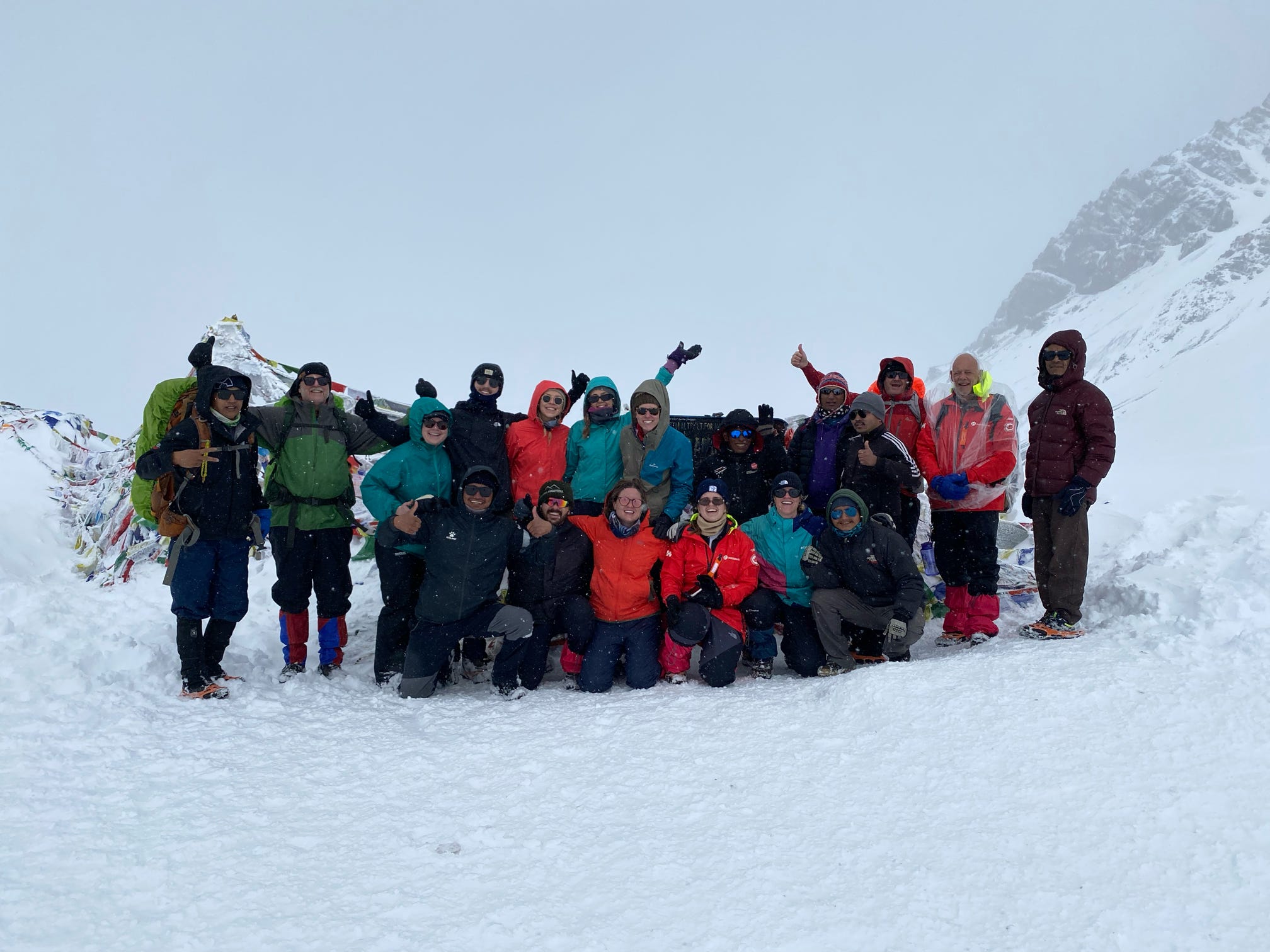
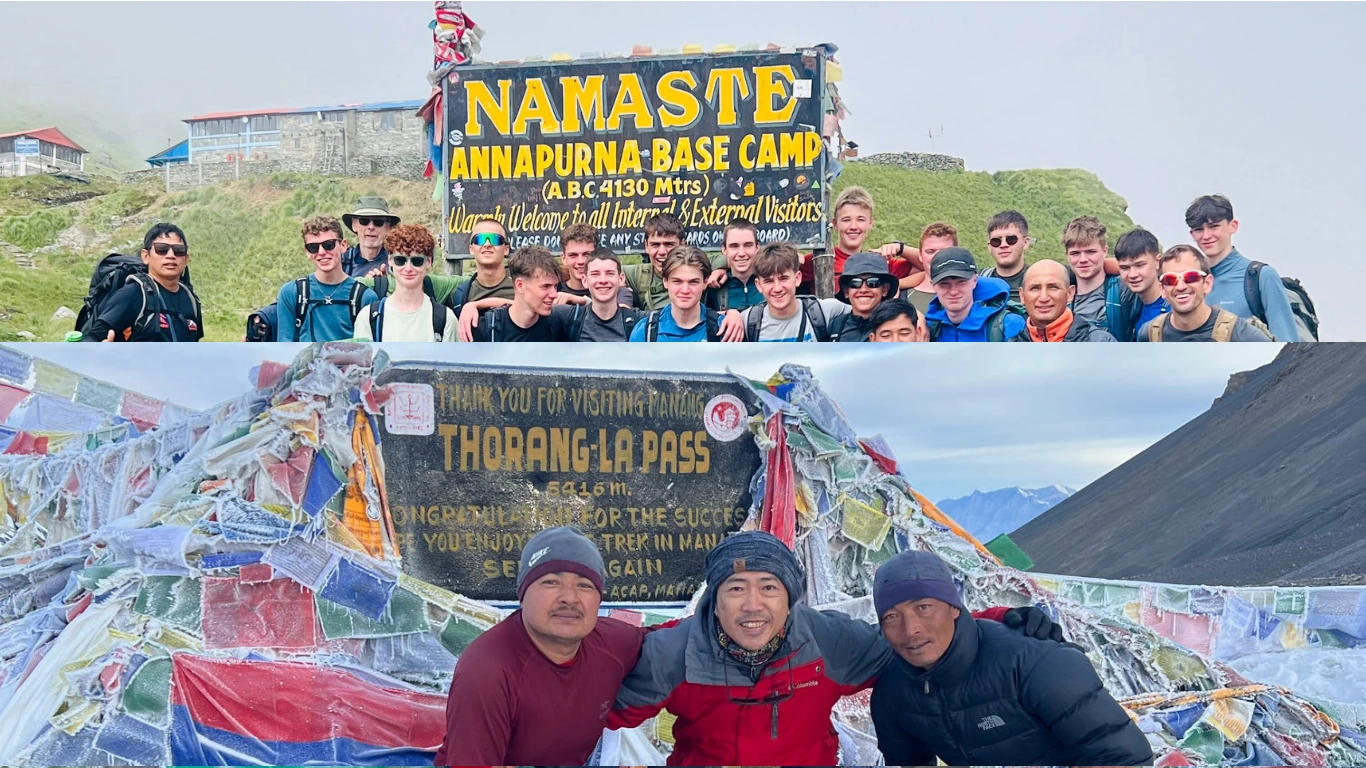
When trekkers study the Annapurna Circuit, their eyes lock onto one number first: 5,416 meters, or 17,769 feet. That’s the altitude of Thorong La Pass, the highest point of the trek and the defining challenge when crossing Thorong La Pass on the route.
Ask the trekkers who’ve actually stood on that pass, though, and a different picture emerges. Crossing Thorong La isn’t really a solo achievement. It’s a result of team coordination, careful pacing, and the kind of support that happens quietly in the background long before anyone starts climbing.
Looking back at our recent departures, the pattern holds. A crossing like this doesn’t just need to be managed. It needs a team that knows how to protect your energy well before you ever reach the ice.
This guide goes beyond the summit photo. It covers what the crossing day actually looks like hour by hour, how guides decide whether conditions are safe, what the porter team handles so you don’t have to, and what trekkers who’ve done it recently have to say about the experience.
Key facts about Annapurna Circuit Trek
| Feature | Annapurna Circuit Trek Details |
|---|---|
| Highest Point on the Annapurna Circuit Trek | Thorong La Pass (5,416 m / 17,769 ft) |
| Annapurna Circuit Trek Terrain | Diverse landscapes ranging from subtropical valleys and forests to high-altitude alpine terrain |
| Trekking Guides and Porter Support | Experienced trekking guides and a dedicated porter team for support along the route |
| Annapurna Circuit Trek Services | Teahouse accommodation arrangements, high-altitude equipment guidance, and cultural insights along the trail |
Thorong La Pass Crossing: Safety, Guides and Preparation.
“Knowledge and calmness under pressure are the real metrics of high-altitude safety.“
Plenty of general travel guides treat guiding and porter support as a nice-to-have convenience. At Lhasso Adventure, we treat it as the actual strategy for the mountain. None of it shows up in a brochure photo, but all of it shapes whether crossing day feels like an adventure or an ordeal.
We spoke with trekkers, including Niamh C. and Rose S., who recently crossed the circuit, about what a well-run ascent actually looks like on the ground.
“We felt in such safe hands the entire time with our guide, Chandra,” Rose S. said after her team’s crossing. “Not only was he extremely knowledgeable and calm in each and every situation, but our group felt so bonded and friendly from day one. I would tell any friend or family member that this is the only way to see Nepal.”
That calm doesn’t happen by accident. Above 5,000 meters, stress burns oxygen your body can’t spare. A guide like Chandra isn’t just pointing out the trail. He’s managing the group’s state of mind, turning high-altitude anxiety into steady, focused momentum instead.
Trekkers often don’t notice this happening in real time. It shows up afterward, in how calm the memory of a genuinely hard day feels once it’s over.
What Crossing Thorong La Pass Day Actually Looks Like, Hour by Hour
Most trekkers imagine the pass as a single dramatic moment. In reality, crossing day is a long, carefully paced sequence that starts well before sunrise and doesn’t end until well into the afternoon.
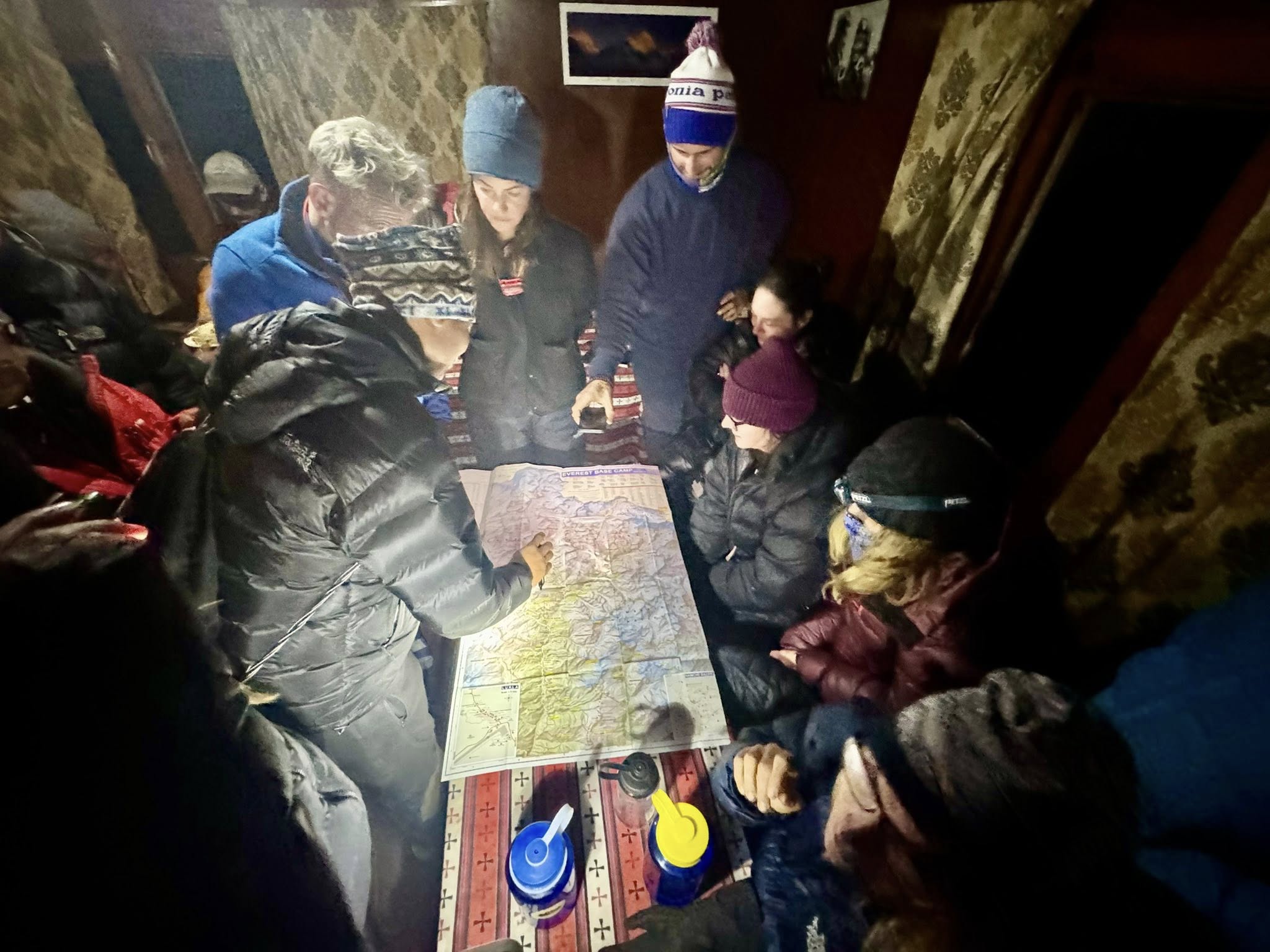
The day begins in the dark, usually between 3:30 and 4:30 in the morning at Thorong Phedi or High Camp. Headlamps come out, breakfast is quick and warm, and the group sets off while the trail is still frozen solid underfoot, which actually makes for easier, more stable footing than the looser scree of daytime.
The first hour or two is the coldest and quietest part of the day. Conversation fades as everyone settles into their own rhythm, breathing deliberately, watching the small circle of headlamp light ahead rather than the dark climb still to come.
As the sky starts to lighten, usually two to three hours in, the pace naturally slows further. This is where altitude is working hardest against you, and where an experienced guide reads the group constantly, watching for anyone falling behind, breathing oddly, or going quiet in a way that signals more than just fatigue.
Reaching the summit, marked by prayer flags snapping in the wind and a small stone shelter, typically happens around mid-morning. The relief is immediate and visible. Photos happen fast, since wind and cold discourage lingering, and then the long descent toward Muktinath begins almost right away.
Managing Your Energy Before the Thorong La Pass
A good crossing comes down to removing small stressors long before the pass itself. Worrying about a sleeping bag rating, second-guessing a trail junction, or eating food that doesn’t sit well all drain cognitive energy you’ll need later, at altitude, when it matters most.
Energy management starts days earlier than most trekkers expect, not on crossing morning itself. The acclimatization days in Manang, the pace between Yak Kharka and Thorong Phedi, even how well you sleep two nights before the push, all feed into how much reserve you have left when it actually counts.
Annapurna Circuit Logistics You Don’t Have to Think About
For your physical performance to stay sharp, the logistics around you need to stay invisible.
As Niamh C. put it after her trip: “Everything went super smoothly on this adventure. We had accommodation and food sorted for us as well as some of the gear, sleeping bags, crampons, hiking poles, making it super convenient.”
Not having to source or carry specialized high-altitude gear yourself removes one more decision, one more thing that could go wrong, from a day that already demands enough focus.
Food That Works as Recovery, Not Just a Meal on Annapurna Circuit Trek
Acclimatization runs on fuel, but eating at altitude shouldn’t feel like a chore. Genuine Himalayan hospitality turns mealtime into part of the recovery itself. Trekkers consistently mention the cultural warmth of these meals alongside the small, unexpected rewards along the way. The local apple pie, in particular, has become an undisputed favorite during long high-altitude evenings.
Appetite often drops at altitude, which is exactly why familiar, genuinely enjoyable food matters more here than it would at sea level. A meal trekkers actually want to finish does more for the next day’s energy than a technically balanced plate nobody touches.
The Porter Team: Dilip, Ashis, and Niraj
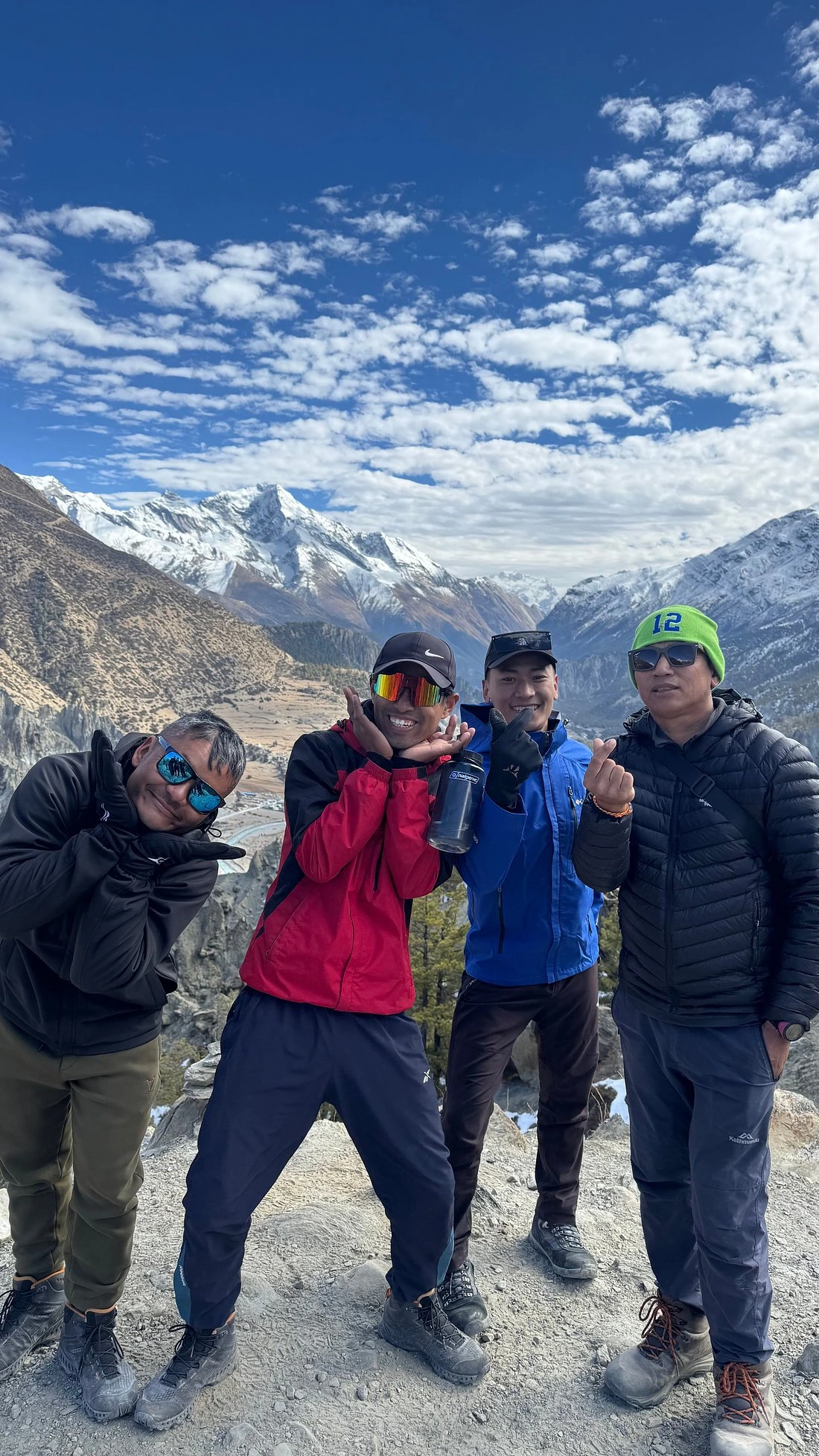
The real backbone of any strong Himalayan team is the porter crew. By managing the heavy loads, porters like Dilip, Ashis, and Niraj let trekkers walk with light packs, clear heads, and steadier heart rates throughout the day.
Their work starts well before trekkers wake up and continues after the group has settled into the next teahouse, moving gear, coordinating with lodge owners, and quietly keeping the whole operation running on schedule.
As trekker Lily E. put it simply: “Our guide Chandra and porters Niraj, Dilip, and Ashis genuinely made the whole experience for us. 10/10.”
Reading the Mountain: How Guides Decide It’s Safe to Cross
Weather at Thorong La can shift fast, and the decision to cross on a given morning isn’t automatic. Experienced guides check conditions the evening before, talking with other guides and teahouse owners who’ve watched the pass for years, building a picture that goes well beyond a single forecast.
Wind matters more than temperature on most mornings. A clear, cold day with calm wind is far safer than a milder day with gusts strong enough to affect balance near the exposed sections close to the summit.
If conditions look genuinely unsafe, the right call is sometimes to wait a day at Thorong Phedi rather than push through on schedule. This isn’t a failure of planning. It’s exactly the judgment that separates a guided crossing from an independent one, where the pressure to stick to a fixed itinerary can override better sense.
Trekkers rarely see this decision-making happen, since it mostly takes place the evening before over tea with other guides. What they experience is simply a crossing day that goes smoothly, without ever knowing how much quiet assessment made that smoothness possible.
Annapurna Circuit Altitude and Safety: What Guides Watch For
Altitude sickness risk peaks on crossing day more than on any other single day of the Annapurna Circuit, simply because trekkers spend hours at the trek’s highest sustained elevation.
Our guides watch for the early, easy-to-miss signs: a headache that doesn’t fade with water, unusual quietness from someone normally talkative, stumbling that isn’t explained by the terrain. Catching these signals early is what prevents a minor symptom from becoming a genuine emergency.
Pace itself is a safety tool, not just a comfort one. Groups that move too fast toward the summit often find altitude catching up with them hard on the final stretch, while a deliberately slower, steadier pace from the start tends to produce a stronger, more comfortable group by the top.
If a trekker does show real symptoms, the response is immediate: descend, don’t push through. A guide’s willingness to turn a trekker back, even close to the summit, is one of the clearest signs of an experienced, safety-first team rather than one focused purely on summit numbers.
Meet the Team Behind the Crossing Thorong La Pass
Guides like Chandra bring years of repeated crossings to a day that, for most trekkers, happens exactly once. That repetition matters enormously. Knowing how the trail changes with fresh snow, where the wind typically picks up, and how different trekkers tend to respond to altitude all comes from doing this specific crossing many times over, not just from general trekking experience.
Porters Dilip, Ashis, and Niraj bring a different but equally essential kind of expertise, built on years of moving loads through exactly this terrain in exactly this kind of cold. Their familiarity with the trail, the teahouses, and the rhythm of a crossing day is part of what lets guides focus fully on the group rather than splitting attention across logistics too.
Together, this kind of team turns a genuinely demanding day into one trekkers describe afterward with more pride than dread, which is really the whole point of building a team this way in the first place.
The Descent: What Happens After the Crossing Thorong La Pass
Reaching the summit is only half the day. The descent to Muktinath drops over 1,600 meters, and it tests concentration and knees in a completely different way than the climb tested lungs.
Trekking poles earn their keep here more than anywhere else on the route. The trail is steep, loose in places, and long enough that fatigue genuinely sets in partway down, right when careful footing matters most.
Arriving in Muktinath, usually by early afternoon, brings a shift in mood that’s hard to overstate. The town itself, with its temples sacred to both Hindu and Buddhist pilgrims, gives the day’s effort a natural sense of arrival rather than just an endpoint on a map.
Many trekkers visit Muktinath Temple that same afternoon or the following morning, a quiet contrast to the physical intensity of the hours before, and a moment several of our trekkers describe as one of the most memorable of the entire trip.
Thorong La Phedi to Muktinath via Thorong La Pass Distance
Crossing day covers roughly 18 kilometers on foot, split between a steep 5-kilometer climb from Thorong Phedi to the summit and a longer 13-kilometer descent into Muktinath. Those numbers alone don’t explain why this single day defines the whole trip, though.
The full Annapurna Circuit runs between 160 and 230 kilometers depending on your starting point, itinerary length, and whether side trips like Tilicho Lake are included. Crossing day sits almost exactly at the trek’s midpoint by distance, but near its very end in terms of difficulty.
Daily distances vary enormously across the route, from flatter 15 to 20 kilometer stretches in the lower valley to shorter, steeper days like this one, where a handful of kilometers takes most of a morning. Judging any single day by its kilometer count alone misses what actually makes it hard.
Trekkers planning their own trip around specific daily distances, rather than just the crossing itself, tend to find the full stage-by-stage breakdown more useful than a single total figure, since it shows exactly where the effort concentrates across the whole itinerary.
Full detailed Annapurna Circuit Trek Map and Route
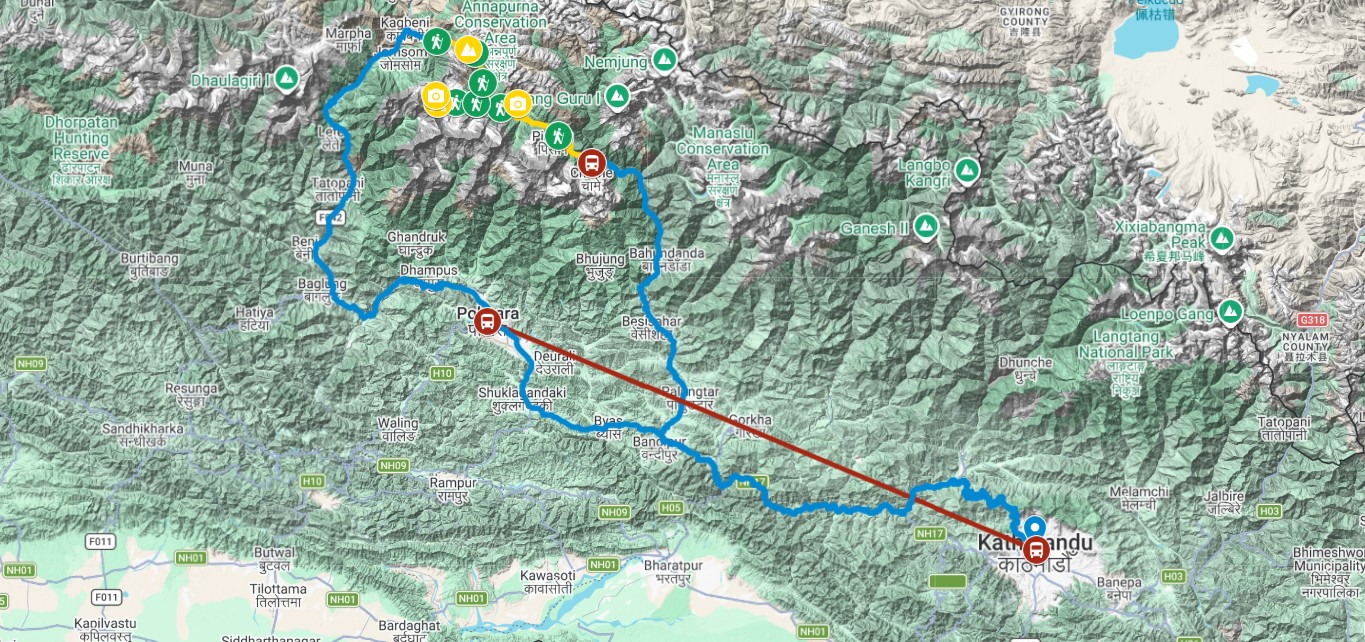
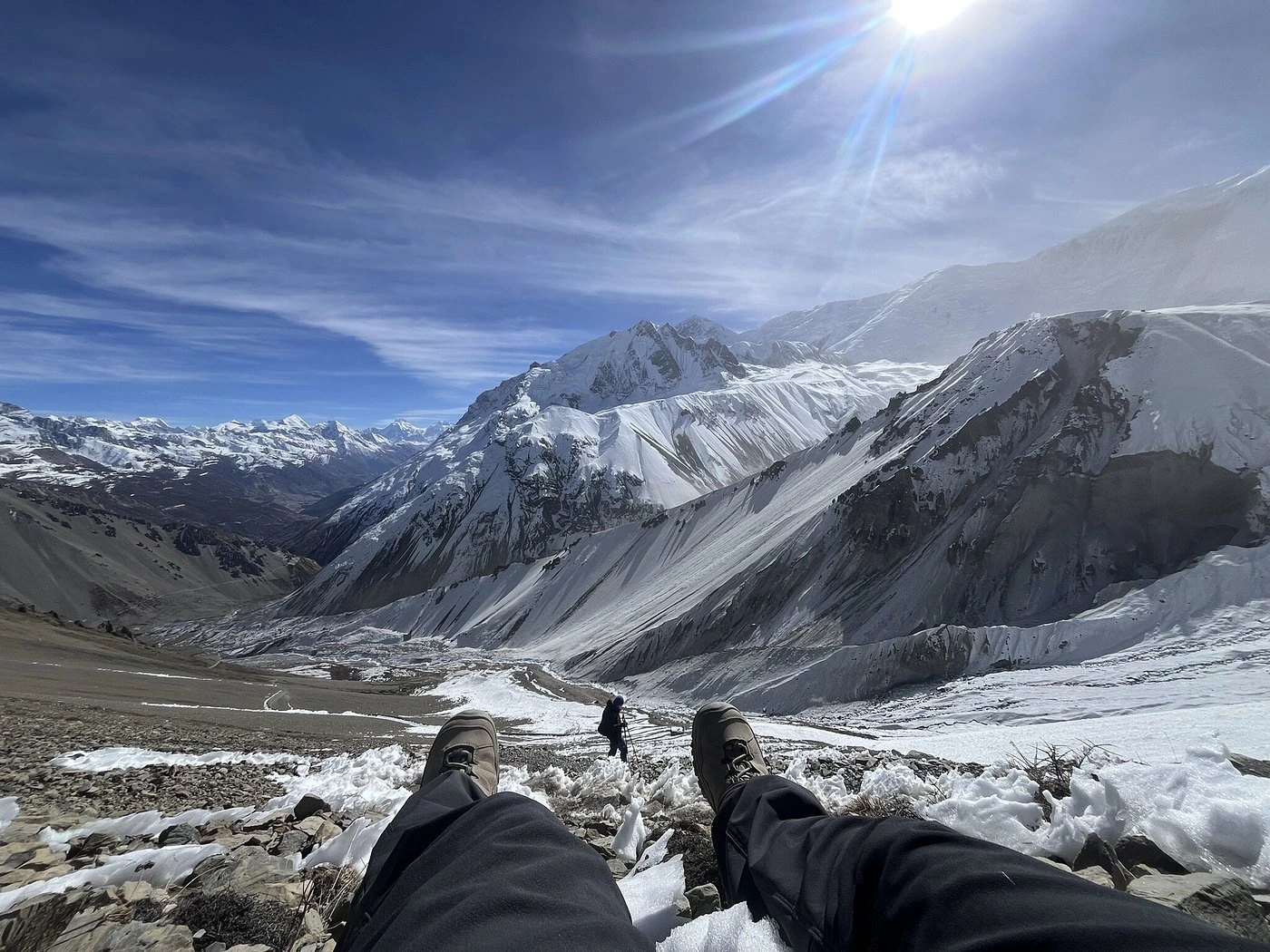
The Annapurna Circuit traces a full loop around the Annapurna massif, rather than an out-and-back trail. It climbs the Marsyangdi valley from Besisahar through Chame and Manang, crosses Thorong La, then descends through Muktinath and Jomsom on the opposite side of the range.
That loop shape is part of what makes the trek feel like a genuine journey rather than a single destination. Trekkers pass through subtropical lowland, pine forest, high desert near Manang, and finally the dry, Tibetan-influenced Mustang valley, all within one continuous route.
On a map, Thorong La sits at the trail’s highest and narrowest point, the single pinch connecting two otherwise very different landscapes. Everything before the pass builds altitude gradually. Everything after it drops away just as decisively.
A proper elevation map makes this shape far easier to understand than distance figures alone, since it shows exactly where the steepest climbing bunches together rather than spreading evenly across the full loop.
The full route distance from Besisahar to Thorong La and beyond
Thorong La is the highest point on the trek, and the highest trekking pass in Nepal, but it’s really the midpoint of a much longer story. The loop starts low, in warm, terraced farmland near Besisahar, and doesn’t return to anything like that elevation until the final days near Pokhara.
Over roughly two to two and a half weeks, the trail climbs steadily through pine forest and river valleys, opens into the drier, high-altitude country around Manang, then pushes up and over the pass before dropping into the Mustang region on the far side. Jomsom and Muktinath feel like an entirely different part of Nepal from where the trek began, shaped by wind, altitude, and centuries of trade with Tibet rather than by the lush valleys lower down.
Trekkers often describe the shape of this journey as its own kind of reward, separate from the pass itself. You’re not simply walking toward one viewpoint. You’re moving through several distinct landscapes stitched into a single loop, with the crossing acting as the hinge between the trek’s two halves rather than its only destination.
Anyone planning out the trip in detail, day lengths, total distance, where the trail follows a road versus a footpath, will find that level of planning covered properly elsewhere. This piece is less about the numbers and more about what the journey actually feels like while you’re in it.
Difficulties Beyond the Thorong La Pass
Thorong La gets most of the attention, and fairly so, but it isn’t the only part of the trek that asks something of you. The early days bring their own challenge in the form of long, humid valley walking, river crossings on swaying suspension bridges, and stone staircases that test your legs well before altitude becomes a factor at all.
Weather lower in the valley can be its own quiet difficulty too. Afternoon cloud and occasional rain in the forested sections make for a different kind of discomfort than the cold, dry air higher up, even if it rarely makes it into the stories trekkers tell afterward.
Altitude itself starts working on you gradually, well before the final push. Trekkers often notice subtle changes, slightly shorter breath, a lighter appetite, poorer sleep, as early as Manang, days before the pass itself comes into view.
All of that builds toward the crossing, which remains the hardest single stretch by a clear margin. But trekkers who go in expecting difficulty only on that one day are sometimes caught off guard by how much the days leading up to it ask of them too, in different, quieter ways.
Where You Sleep Each Night: Accommodation on the Annapurna Circuit Trek Trail
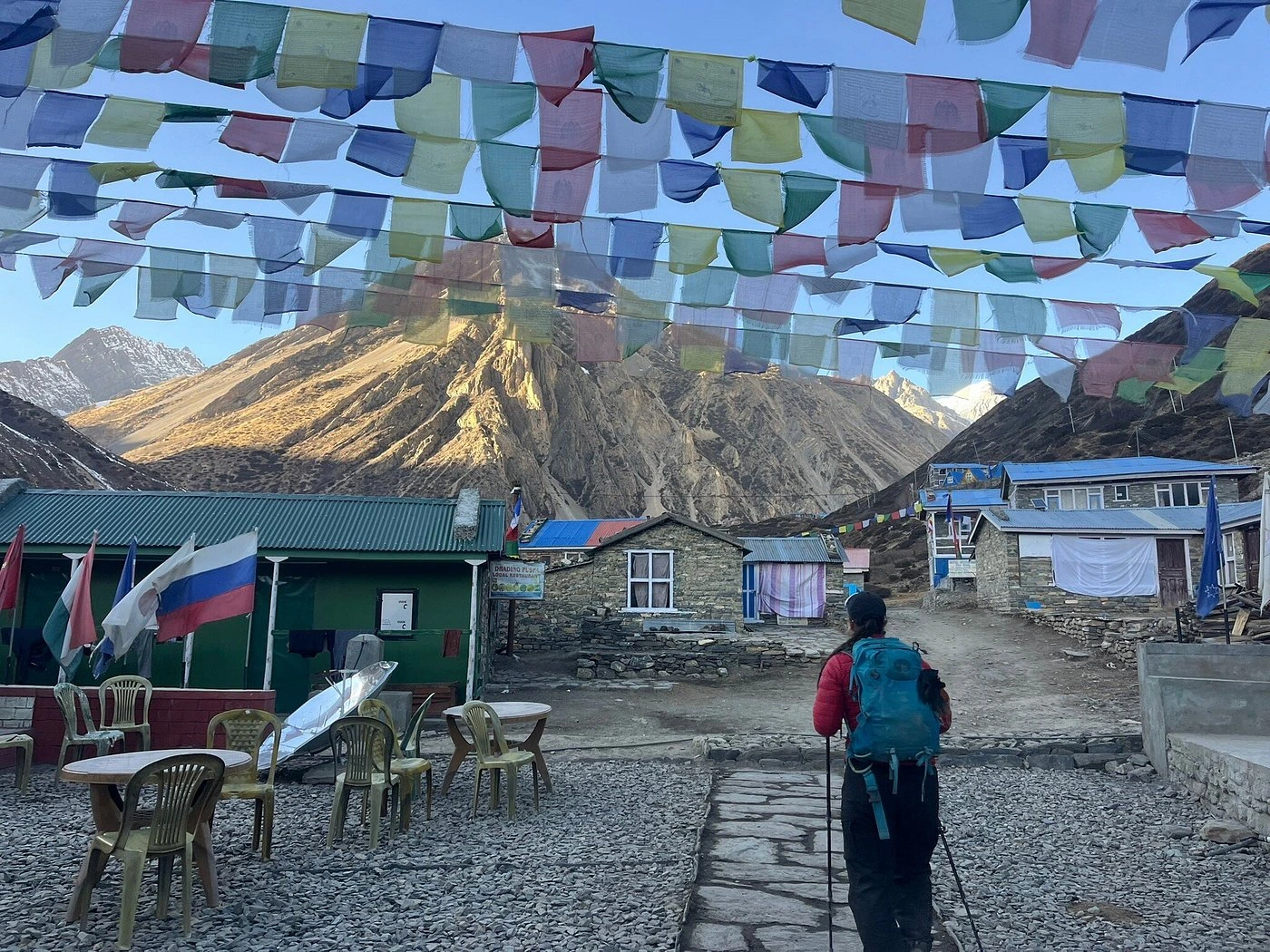
Teahouses define accommodation on the Annapurna Circuit, simple lodges in nearly every village, usually offering a basic twin room and a shared bathroom down the hall. Lower in the valley, these rooms often come with reliable hot showers and decent WiFi. Higher up, both become less dependable, and sometimes disappear entirely for a night or two.
The real heart of a teahouse isn’t the room, though. It’s the dining hall, usually warmed by a central stove, where trekkers from different groups end up sharing stories, playing cards, and comparing notes on the day’s walk once the sun goes down and the temperature drops.
Above Manang, teahouses grow noticeably more basic. Walls thin out, heating becomes limited to that one shared stove, and the sleeping bag you brought stops being optional. At Thorong Phedi, the night before the crossing, most trekkers go to bed early, aware of the alarm set for the dark hours ahead.
After the pass, Muktinath’s teahouses feel like a small luxury by comparison, a warm room and a hot meal arriving right when both matter most.
Overall Experience: The Annapurna Circuit and Thorong La Pass Together
Taken as a whole, the Annapurna Circuit is less about any single highlight and more about how distance, route, difficulty, and accommodation all build toward one defining day. Everything before Thorong La is preparation, and everything after it is a kind of extended exhale.
Thorong La Pass is often described as one of the highest trekking passes in Nepal and the world, and while a handful of more remote, technical crossings in restricted areas sit slightly higher, 5,416 meters remains the highest point reached on any of Nepal’s major teahouse-supported trekking routes. That’s really where its reputation comes from, not a literal claim to the single highest pass in the country.
Trekkers who complete the full circuit tend to describe the experience less in terms of the pass alone and more as a complete arc: the warmth of lower villages, the stark beauty above Manang, the quiet tension of the night before crossing, the pass itself, and finally the relief and culture waiting in Muktinath.
That arc, more than any individual number, is what keeps bringing trekkers back to this route, and why a guided crossing with a team that understands every part of it tends to produce the kind of experience trekkers describe with pride long after the blisters have healed.
Why This Kind of Annapurna Experience Still Matters
Parts of the Annapurna region continue to modernize, with roads reaching further into the valley each year. Even so, the classic foot-trail circuit remains a genuine sanctuary of culture and scale, provided you walk it with a team that actually knows the terrain.
From the deep valleys around Manang to the stark, Mustang-side descent into Muktinath, trekking with a dedicated local team means you don’t just pass through the culture. You come to understand it: the stories behind the peaks, the history of the villages, and the traditions still carried by the people who call this landscape home.
Thorong La stays the hardest single day on the whole route, both for the altitude and for how much the crossing depends on timing and weather judgment that only comes from doing it repeatedly. Trip cost and exact logistics shift with group size and season, details worth checking against your own travel dates rather than assuming a fixed figure applies to every departure.

Crossing Thorong La Pass: Annapurna Circuit Trek FAQ
Do I really need technical gear like crampons and hiking poles for Thorong La Pass?
Yes. Conditions on the pass can shift from dry scree to hardpack ice within a matter of hours. Lhasso Adventure provides pre-vetted, high-quality gear, including sleeping bags, crampons, and poles, so you get professional-grade equipment without hauling extra weight from home.
What makes a private trek with Lhasso Adventure different from a mass-market group tour?
Mass-market tours tend to move clients through like numbers on a schedule. We build dedicated field teams instead. Trekking with guides like Chandra and a consistent porter team gives you a safety net that adapts to your group’s actual pace, not a fixed itinerary regardless of how anyone is feeling.
Why does the pass feel so much harder than its distance suggests?
Because the 5 kilometers from Thorong Phedi to the summit climb nearly 1,000 meters through thinning air. Distance alone never tells the real story on this stretch, which is exactly why pacing and guide judgment matter more here than anywhere else on the route.
Is crossing Thorong La something a first-time trekker can realistically do?
Yes, with the right preparation and support. The crossing isn’t technical, but it rewards trekkers who’ve acclimatized properly and are walking with a team that knows how to read the mountain’s conditions on the day, rather than following a fixed schedule regardless of weather.
What happens if the weather looks bad on the morning you’re scheduled to cross?
An experienced guide delays rather than pushes through. Waiting an extra day at Thorong Phedi is a normal, sensible outcome, not a sign anything has gone wrong, and it’s exactly the kind of judgment call that matters more than sticking rigidly to a printed itinerary.
How steep is the descent into Muktinath compared to the climb up to the pass?
Steeper in effect, if not in grade, since it drops more than 1,600 meters in roughly 13 kilometers after a morning that’s already tired your legs. Many trekkers find the descent tougher on their knees than the climb was on their lungs, which is why a slower, pole-assisted pace matters just as much heading down as it did heading up.