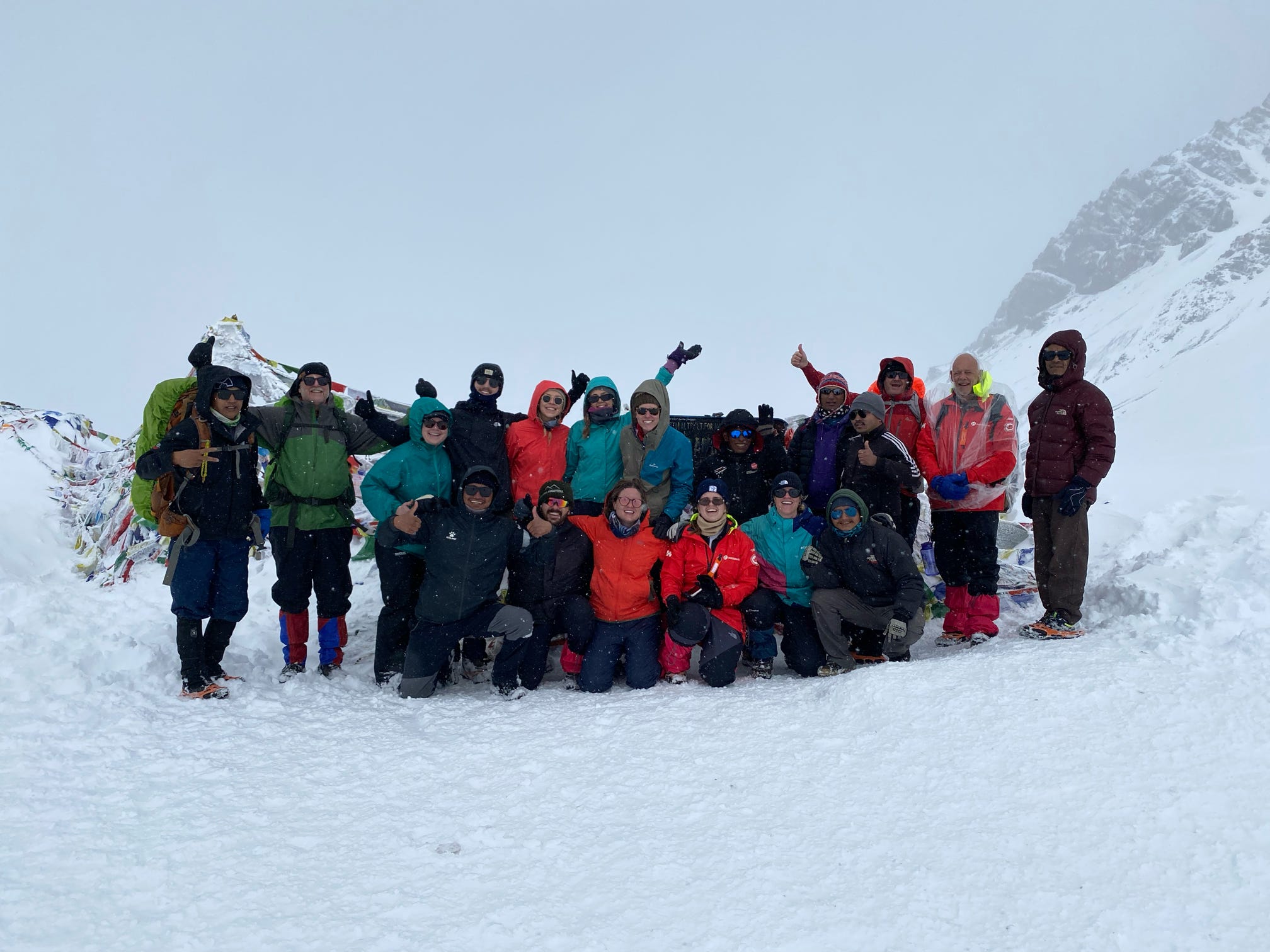
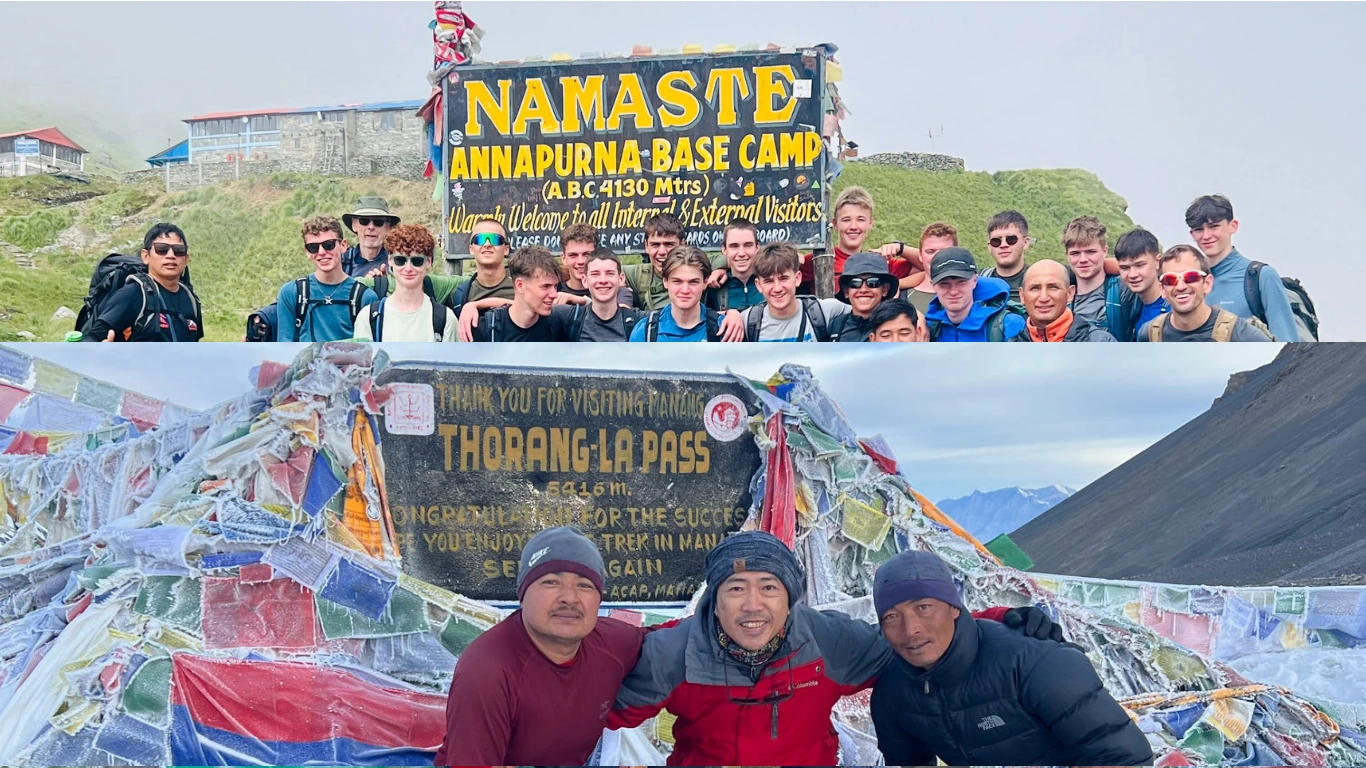
Luxury Everest Base Camp Trek with Helicopter Return
September 10, 2026 Lhasso Adventure
The Luxury Everest Base Camp Trek with Helicopter Return is an 11-day trekking itinerary. You walk the full route to Base Camp on foot, the same way every trekker does, then fly back to Kathmandu by helicopter from Gorak Shep instead of walking the three to four day descent.
That single swap, flying instead of walking down, is what shortens the standard 14-day Everest Base Camp Trek itinerary to 11 days. Everything else, the trail, the lodges, the acclimatization schedule, stays the same. This guide covers the itinerary, the price, and what’s included, along with how to tell it apart from a much shorter aerial-only option some trekkers confuse it with.
What Is the Luxury Everest Base Camp Trek with Helicopter Return?
This is a real trek, not a flight tour. You walk through Phakding, Namche Bazaar, Tengboche, Dingboche, and Lobuche, reaching Base Camp and Gorak Shep entirely on foot, following the same trail every trekker on this route uses regardless of how their trip ends.
The difference from a standard luxury departure shows up only at the very end. Instead of retracing that trail back down through Namche and into Lukla, you board a helicopter at Gorak Shep and fly directly to Kathmandu. Nine days of walking still happen either way; only the final leg changes.
Lodge quality follows the same upgraded standard used across the rest of our premium departures. Heated rooms and thicker bedding replace the more basic teahouse setup, most noticeably in the villages below Dingboche, where better insulation and a wider evening meal selection are still realistic to expect before the terrain climbs into thinner, harder-to-supply territory.
Guiding and safety protocols don’t scale down just because part of the trip happens by air. The same licensed guide standard, daily oxygen monitoring above 3,000 meters, and acclimatization pacing apply here exactly as they do on any of our other departures, since flying back doesn’t change how the body needs to adjust on the way up.
This trip suits trekkers who want the genuine achievement of walking to Base Camp, without spending several extra days walking back down once they’ve already reached it. It also appeals to trekkers with a firm return flight home, since the helicopter segment removes several days of built-in schedule risk that a walking descent carries.
Luxury Everest Base Camp Trek with Helicopter Return: 11-Day Itinerary Overview
The ascent covers roughly nine days, from Lukla through to Gorak Shep, including the two acclimatization days at Namche Bazaar and Dingboche that stay fixed on this itinerary the same way they do on every safe departure through the Khumbu. Skipping either one isn’t an option, regardless of how the trip ends.
The final trekking day reaches Gorak Shep, with Base Camp itself included the same day or the following morning, weather and pacing permitting. From there, rather than an overnight walk back through Namche, the helicopter departs directly for Kathmandu, cutting what would otherwise be three to four additional trekking days off the total trip length.
Kathmandu bookends the trip with a night before departure for your briefing and gear check, and a night after return once the helicopter lands back in the city. Some trekkers extend this second Kathmandu stay by a day or two, given how much time the shorter itinerary frees up compared with a full walking descent.
Exact daily timings shift slightly with weather and group pacing, particularly around the Gorak Shep departure day, since that’s the one day where the walking schedule and the flight schedule need to line up. Confirming the day-by-day breakdown directly with our team before booking is worth doing for that reason, especially if you’re also trying to plan a tight connection home.
Luxury Everest Base Camp Trek with Helicopter Return: Route Map
Seeing this itinerary laid out on a map makes the walking-versus-flying split easier to picture than a day-by-day list alone. The trail itself runs identically to the standard route: Lukla, Phakding, Namche Bazaar, Tengboche, Dingboche, Lobuche, and Gorak Shep, with Base Camp reached as a short detour from the trail rather than an overnight stop.
Where this map looks different from a standard trekking map is the return leg. Instead of a walking line retracing those same villages back down to Lukla, the map shows a single flight path from Gorak Shep straight to Kathmandu, skipping the lower Khumbu entirely on the way back.
| Waypoint | Elevation | Mode |
|---|---|---|
| Lukla | 2,860 m | Trek starts |
| Phakding | 2,650 m | Walking |
| Namche Bazaar | 3,440 m | Walking (acclimatization stop) |
| Tengboche | 3,867 m | Walking |
| Dingboche | 4,410 m | Walking (acclimatization stop) |
| Lobuche | 4,930 m | Walking |
| Gorak Shep | 5,164 m | Walking in, helicopter out |
| Everest Base Camp | 5,364 m | Walking detour from Gorak Shep |
| Kathmandu | 1,400 m | Helicopter return |
This is roughly half the elevation and distance picture most trekkers expect from a standard round-trip map, since the walking distance stays the same on the way up but drops to nothing at all on the way down, replaced entirely by the helicopter leg shown above.
Inter-village distances on the ascent follow the same figures as any standard departure through the Khumbu, since the trail itself, its suspension bridges, and its daily elevation gain don’t change based on how a trekker plans to leave, only how they intend to get back to Kathmandu once they’ve reached Base Camp.
Kala Patthar Summit: Optional on the Heli Return Trek
On the standard walking itinerary, the pre-dawn Kala Patthar climb is a fixed, expected stop. On this 11-day version, it’s optional, and that distinction is worth understanding before you book rather than discovering on the trail itself.
The reason comes down to timing rather than difficulty. Kala Patthar is normally climbed before sunrise from Gorak Shep, then trekkers descend and continue walking down the valley over the following days. Here, that multi-day descent doesn’t happen, so the helicopter’s departure window sometimes doesn’t leave enough room for the full pre-dawn round trip beforehand.
Trekkers who specifically want the Kala Patthar sunrise view should flag this with their guide in advance, so the day gets planned with enough buffer before the helicopter’s scheduled departure. It’s genuinely achievable on most departures, just not automatic the way it is on the standard walking trek, and weather on the summit morning still plays its own role regardless of how well the timing is planned.
Skipping Kala Patthar doesn’t mean skipping the mountain views entirely. Base Camp itself, reached the previous day, stays part of the itinerary regardless of how the Kala Patthar timing works out, and many trekkers find that view alone matches what they came for.
Luxury Everest Base Camp Trek with Helicopter Return: Price
Pricing for this 11-day trek follows the same group-size structure used across our luxury departures generally, since the trekking days, lodges, and guide support are nearly identical to the standard luxury trek. The helicopter segment replaces the walking descent rather than adding a separate cost layer on top of an otherwise unrelated trip.
| Group Size | Approximate Price Per Person |
|---|---|
| 2–4 pax | US$4,870 |
| 5–7 pax | US$4,467 |
| 8–10 pax | US$4,288 |
| 11–13 pax | US$4,116 |
| 14–16 pax | US$3,910 |
These figures reflect our standard luxury trek pricing tiers as a baseline. Because the helicopter return is built into this specific itinerary rather than offered as an optional add-on, final pricing should be confirmed directly with our team before booking, since a mandatory helicopter segment can shift the total slightly compared with a walking-descent departure.
Group size still moves the price the same way it does on every other trek we run. A group of fourteen to sixteen trekkers typically pays several hundred dollars less per person than a group of two to four booking the identical itinerary, purely because fixed costs like guide fees spread further across a larger group.
Luxury Everest Base Camp Trek with Helicopter Return: Cost Included
This package includes everything the standard luxury trek does, with the walking descent replaced by the Gorak Shep helicopter segment. Accommodation covers a 3-star Kathmandu hotel with breakfast for your pre- and post-trek nights, plus upgraded lodge accommodation on the trail where available, twin-sharing throughout.
Transportation includes your Kathmandu-Lukla-Kathmandu flights, private ground transfers as needed, and the Gorak Shep-to-Kathmandu helicopter segment itself. Meals on the trail are fully covered, along with purified drinking water and hot drinks throughout the trek.
Your guide is a licensed, government-certified, English-speaking trekking professional, supported by porters carrying your gear under the standard weight limit. Daily oxygen saturation monitoring above 3,000 meters applies here just as it does on every other departure we run.
Permits are included too: the Sagarmatha National Park Entry Permit, the Khumbu Pasang Lhamu Rural Municipality Permit, and the TIMS card, along with all applicable government taxes.
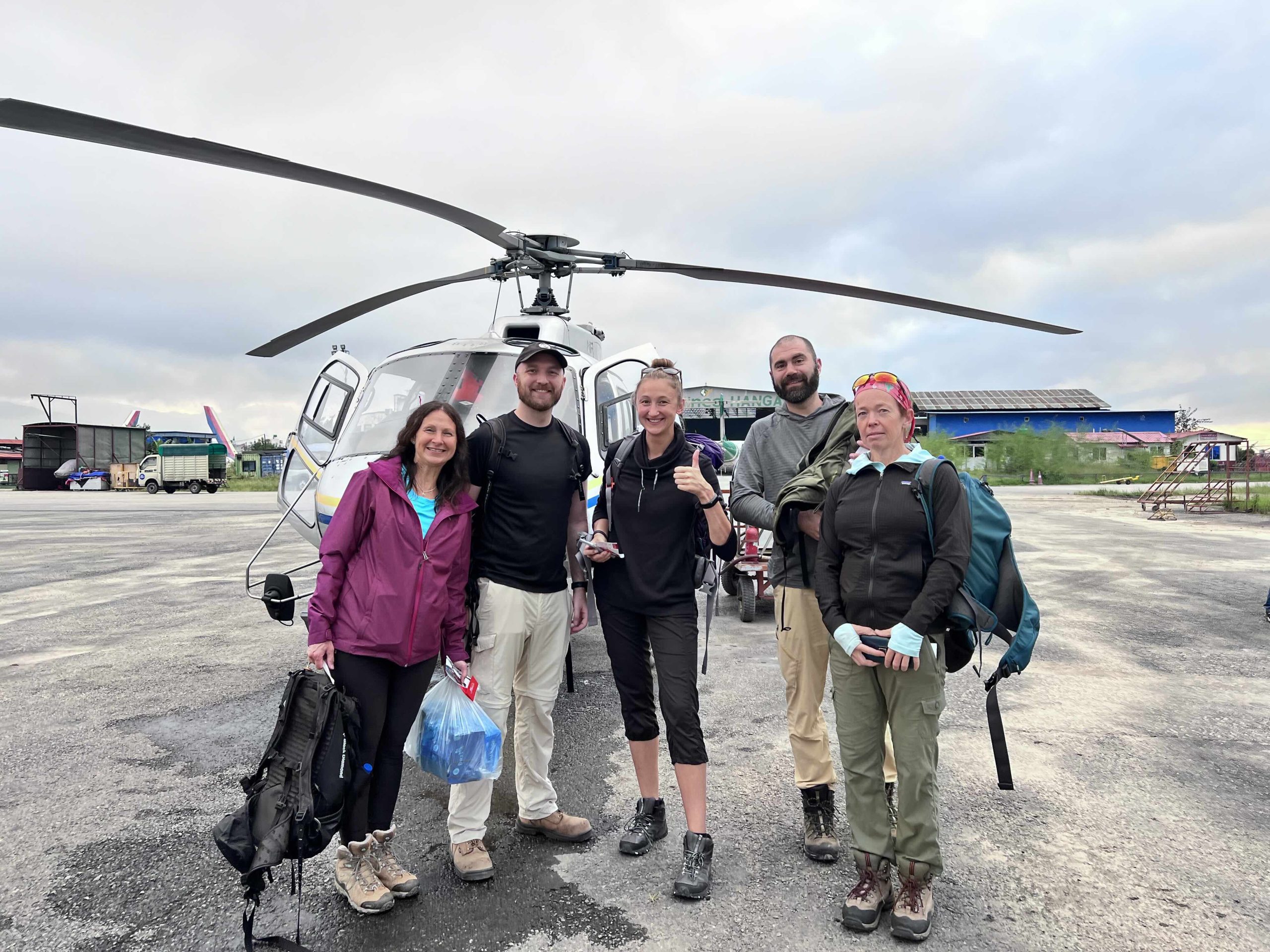
What’s Not Included in the Luxury Trek with Helicopter Return
International flights and Nepal’s entry visa sit outside this package, the same as every other trek we run. Travel insurance with helicopter evacuation coverage is essential and needs to be arranged separately, particularly given the helicopter segment already built into this itinerary rather than left as something to add on later.
Personal expenses, including wifi, laundry, bar bills, and souvenirs, aren’t included. Tips for your guide and porters follow the same standard practice as our other departures, and are worth budgeting for separately rather than assumed to be folded into the package price.
Weather-related delays to the helicopter segment itself can occasionally add an unplanned cost or an extra night in Kathmandu, since helicopter flights face the same weather sensitivity as the standard Lukla flight. Building a buffer day into your travel plans protects against this, particularly if your international flight home is scheduled tightly against your expected return date.
Best Luxury Everest Base Camp Heli Trek: What to Look For
Not every operator running this style of trip delivers the same quality, and a few specific details separate a well-run package from a corner-cut one. Start with the helicopter provider itself, confirming it’s a licensed Nepali aviation company with a documented safety record rather than a subcontracted arrangement your operator can’t clearly explain.
Weather contingency planning matters more here than on a standard trek, since a helicopter segment adds a second weather-dependent leg on top of the Lukla flight. Ask how your operator handles a weather-delayed helicopter, including whether a buffer day or a walking-descent fallback is already built into the plan.
Guide quality and group size shouldn’t drop just because a trip includes a helicopter segment. Every guide on this route should carry the same government trekking license and altitude-monitoring routine used across a genuinely safe departure, a detail worth confirming directly whenever a low headline price doesn’t quite match the safety credentials being advertised.
Transparent, itemized pricing is the last marker worth checking. A quote that clearly separates the trekking package from the helicopter segment, rather than folding both into a single vague number, makes it easier to compare operators fairly.
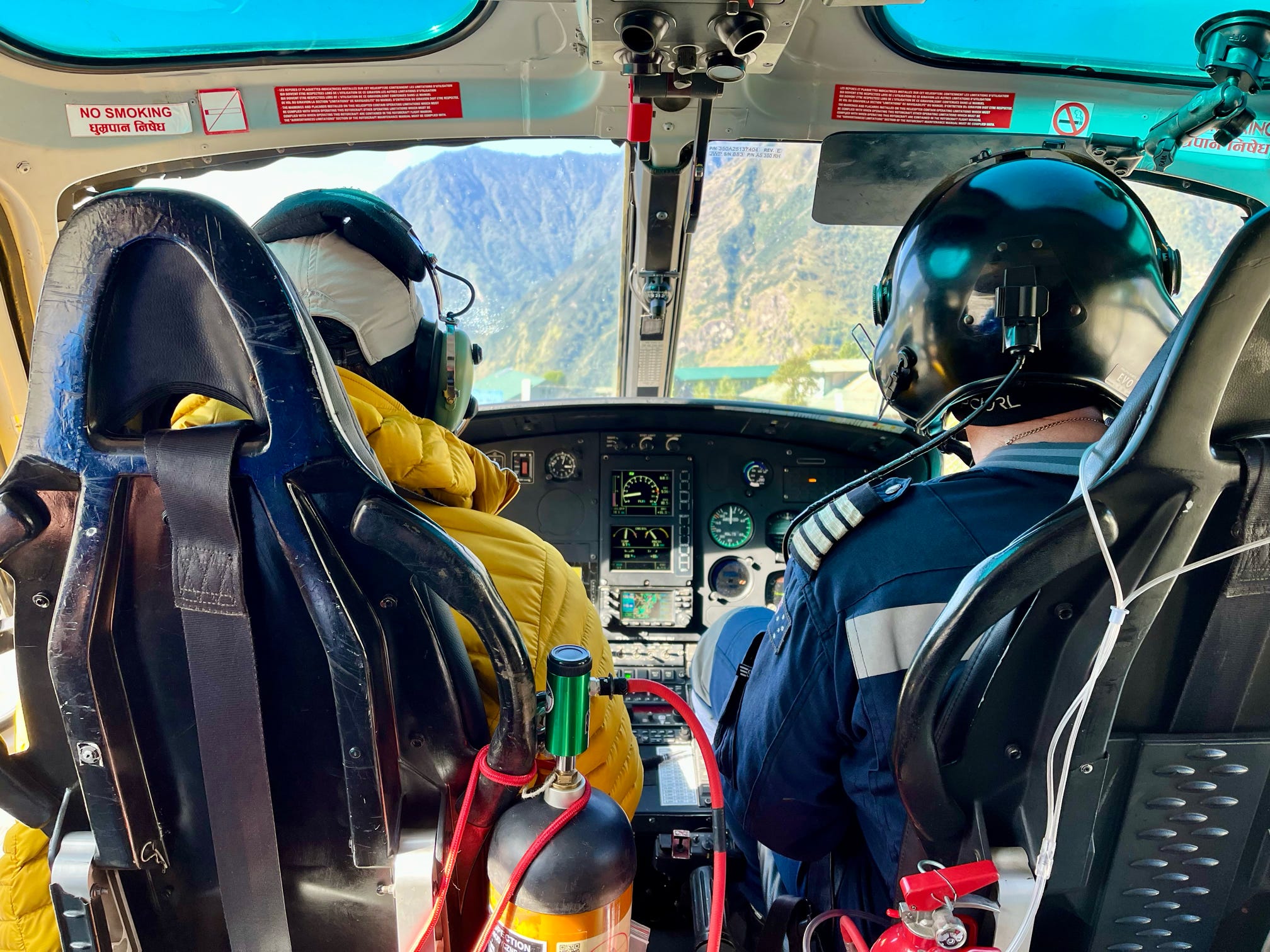
Luxury Everest Base Camp Trek with Helicopter Return: Reviews
Feedback on this specific trip style tends to cluster around one recurring theme: trekkers consistently value reaching Base Camp on foot while being relieved not to face the long walk back down afterward, particularly on tired legs after nine demanding trekking days through increasingly thin air.
The Kala Patthar timing trade-off comes up in feedback too. Trekkers who coordinated it in advance with their guide generally report catching the sunrise view without issue, while those who didn’t ask ahead sometimes missed it due to the tighter helicopter schedule that morning, a detail that tends to surprise first-time trekkers more than repeat ones.
Weather delays are the most commonly mentioned frustration, consistent with any helicopter-dependent itinerary in this region. Trekkers who built a buffer day into their travel plans reported far less stress when a delay did occur than those who booked a tight return flight home the same day the helicopter was scheduled to land.
Overall satisfaction tracks closely with expectations set before departure, the same pattern seen across every trek style we offer. Trekkers who understood this was still a full multi-day trek, not a shortcut, consistently reported the experience matched what they’d signed up for, while trekkers expecting an easier version of the standard route sometimes underestimated the nine ascent days ahead of the flight.
Everest Base Camp Trek Nepal Companies: Choosing the Right Operator
Nepal has a wide range of operators running Everest Base Camp trips, and quality varies considerably between them, particularly for a specialized product like a helicopter-return trek that requires coordinating two separate logistics chains, trekking and aviation, at once rather than just one.
Look for a company that holds proper trekking agency registration and works directly with a licensed helicopter operator, rather than routing that coordination through a third party your main operator can’t personally vouch for. This distinction matters more on this trip than on a standard walking trek, since a weak aviation partnership shows up exactly when you need it most.
Guide qualifications remain the clearest signal of a company worth trusting. A government-licensed guide with real experience leading groups on this exact route matters more than a polished website or a low headline price that doesn’t explain what it’s actually built from.
Trekkers comparing several operators side by side tend to find that the ones willing to walk through exactly how their pricing breaks down between the trekking package and the helicopter segment are also the ones with the clearest safety and weather-contingency answers when asked directly. An operator that hesitates on either question is worth a second look before booking.
Weather and Helicopter Reliability on This Route
A helicopter segment doesn’t remove weather risk from this trip; it just moves that risk to a different point in the itinerary. Where a standard trek risks a delayed Lukla flight on either end, this itinerary adds a second weather-dependent leg at Gorak Shep specifically.
Cloud cover and wind are the main factors that can delay a helicopter departure from that altitude, and both are more common in the early morning hours right after the coldest part of the night. Afternoon departures, when conditions have had time to stabilize, tend to see fewer delays than an early morning attempt.
A short delay of a few hours is the most common outcome when weather does interfere, rather than a full-day cancellation, though multi-day cancellations aren’t unheard of during unstable stretches of weather. This is exactly why a buffer day before your international flight home matters as much here as it does on any trek that depends on a Lukla flight.
If a helicopter delay does stretch longer than expected, walking the standard descent remains available as a fallback, coordinated with your guide on the ground rather than left as a gap in the plan. This isn’t the preferred outcome for a trip built around avoiding that walk, but it exists as a safety net rather than leaving trekkers stranded at Gorak Shep with no way down.
Everest Luxury Trek and Everest Base Camp Luxury Trek: Where This Fits
This 11-day heli-return option is one of two ways to trek Everest Base Camp at a luxury comfort level. Our standard 14-day Everest Base Camp departure, with a full walking descent, is the other, and both share the same Route to Everest Base Camp, guide quality, and Kathmandu hotel tier.
Choosing between the two comes down to time and preference rather than comfort level. A trekker with a tighter schedule, or simply no interest in walking the descent twice over, leans toward this 11-day version. A trekker who wants those final few days on the trail, revisiting villages from a different direction, tends to prefer the walking descent instead.
Group size shapes the total price on both versions in the same way, with larger departures consistently landing at a lower per-person rate than a small group of two or three booking either itinerary.
Trekkers drawn to the word “luxury” specifically, without a strong preference on the return method, are well served by either option, since the real decision point is simply how those final days are spent.
Limited on Time? A Helicopter-Only Option Also Exists
For travelers who can’t spare 11 days but still want to see Everest up close, we also run a separate one-day helicopter tour. It flies from Kathmandu into the Khumbu, lands briefly for an aerial view near Base Camp, and returns to Kathmandu the same day, with no trekking involved at all.
This is a different product from the trek covered throughout this guide, built for a different kind of traveler. Ask our team about it directly if a full multi-day trek isn’t what you’re looking for.
How Lhasso Adventure Runs Luxury Everest Base Camp Trek with Helicopter Return Trip
Both the trekking route and the helicopter segment on this itinerary are coordinated by the same team managing every other departure we run, so the transition from trail to aircraft happens as one planned trip rather than two disconnected bookings handed off between separate companies.
Trekking leaders Bhim Tamang and Gopal Raj Lama lead the walking portion with the same pacing and altitude awareness applied across all our departures, coordinating directly with our licensed helicopter partner for the Gorak Shep pickup so the flight is scheduled around your group’s actual progress, not a fixed date set months in advance.
We can walk you through current pricing and the exact day-by-day breakdown for this 11-day trek directly, since a mandatory helicopter segment is worth confirming in detail before booking rather than assuming a fixed figure applies to every departure regardless of season or group size.
Frequently Asked Questions For Luxury Everest Base Camp Trek with Helicopter Return
What is the Luxury Everest Base Camp Trek with Helicopter Return?
It’s an 11-day trekking itinerary where you walk the full route to Base Camp, then fly back to Kathmandu by helicopter from Gorak Shep instead of walking the standard three to four day descent.
How much does the Luxury Everest Base Camp Trek with Helicopter Return cost?
Pricing follows the same group-size tiers as our standard luxury trek, starting from roughly US$3,910 per person for larger groups up to US$4,870 for smaller groups, with final pricing confirmed directly given the built-in helicopter segment.
Is Kala Patthar included in the 11-day trek with helicopter return?
Kala Patthar is optional on this itinerary rather than a fixed stop, since the pre-dawn climb needs to be coordinated around the helicopter’s departure schedule from Gorak Shep.
How is this different from a helicopter tour of Everest Base Camp?
This is a full 11-day trek where you walk to Base Camp on foot. A separate helicopter-only tour exists for travelers with limited time, flying in and out the same day without any trekking involved.
Does the helicopter land at Everest Base Camp itself?
The helicopter picks trekkers up from Gorak Shep, near Base Camp, for the return flight to Kathmandu. Base Camp itself is reached on foot during the trek, not by helicopter.