Everest Base Camp Trek by Jeep: Cost, Route & Distance Guide
September 18, 2026 Lhasso Adventure
The Everest Base Camp trek by jeep replaces the short Lukla flight with a road journey from Kathmandu to Salleri and Surke, covering roughly 300 kilometers by jeep before trekking begins. A shared jeep seat costs around USD 25 to 30 per person to Salleri, while a private jeep for the same leg runs closer to USD 200 to 325 depending on vehicle size and season.
This route exists mainly as an alternative for trekkers who’d rather avoid the notoriously weather-sensitive Lukla flight, or who simply want a slower, more scenic approach through Nepal’s mid-hills before joining the classic Everest Base Camp trail. It adds two to three extra days to the trip compared with flying, in exchange for lower flight-related risk and a genuinely different travel experience.
What Is the Everest Base Camp Trek by Jeep?
The jeep route is a road-based alternative to the standard Lukla flight, driving trekkers from Kathmandu through the mid-hills of Solukhumbu to Salleri, then on to Surke, where the trekking portion of the journey begins and joins the main Everest Base Camp trail near Chaurikharka.
Trekkers choosing this option are typically drawn to one of two things: avoiding the Lukla flight’s frequent weather delays, or wanting the extra depth of experience that comes from moving overland through lower-altitude villages before reaching the high Khumbu. Neither reason is more valid than the other, and many trekkers end up choosing this route for a combination of both.
For a deeper look at the experience itself, including why this slower approach appeals to trekkers who value cultural immersion alongside the destination, the complete guide to the overland route via Salleri and Surke covers the narrative side of this journey in more depth than a pure cost and distance breakdown can offer, including what daily life looks like in the villages passed along the way.
This guide focuses specifically on the practical side: what the jeep segments cost, how far each leg actually runs, and how the road journey connects to the standard trekking trail once the vehicle portion of the trip ends at Surke. Both perspectives are worth reading before deciding whether this route fits your own trip.
Everest Base Camp Trek by Jeep Cost
Jeep costs on this route depend heavily on whether you book a shared seat or a private vehicle, and pricing shifts somewhat by season and road conditions. The figures below reflect typical market rates for this journey.
| Leg | Shared Jeep (per person) | Private Jeep (full vehicle) |
|---|---|---|
| Kathmandu to Salleri | USD 25–30 | USD 200–325 |
| Salleri to Surke | USD 25–50 | USD 150–250 |
| Kathmandu to Surke (combined) | USD 50–80 | USD 400–475 |
Shared jeeps typically seat 7 to 8 passengers and depart early in the morning, usually between 4:00 and 5:00 AM, to reach Salleri by evening. Private jeeps cost considerably more per booking but offer a flexible departure time and more comfortable seating for the long drive, which some trekkers prefer given how demanding the road itself can be over a full day of travel.
Meals along the route aren’t included in the jeep fare regardless of which option you choose, and are typically paid for separately at roadside teahouses and restaurants during scheduled stops. A modest daily budget of USD 10 to 15 covers breakfast and lunch stops on the road comfortably without needing to plan each meal in advance.
Booking this transfer through a trekking operator as part of a full package, rather than arranging it independently, generally folds this cost into the overall trip price shown in the full Everest Base Camp trek cost breakdown, removing the need to negotiate jeep fares separately or coordinate pickup logistics on your own.
Seasonal pricing shifts are worth expecting too. Jeep fares tend to run slightly higher during the busiest trekking months of October and November, when demand for vehicles heading toward Solukhumbu increases alongside overall trekking traffic through the region.
Everest Base Camp Trek by Jeep Route Map
The route runs in a fairly straightforward line from Kathmandu east into the mid-hills of Solukhumbu, following the BP Koirala Highway before switching to rougher, unpaved roads as the journey approaches Salleri. From there, the road continues, though in noticeably rougher condition, toward Surke.
Kathmandu sits at roughly 1,400 meters, and the road climbs gradually to Salleri at around 2,360 meters, passing through mid-hill villages, river valleys, and terraced farmland along the way. This section of the drive covers the bulk of the total distance and the majority of the paved road surface, making it the more comfortable half of the two-day journey.
From Salleri, the road becomes considerably rougher and less consistently maintained, winding through smaller villages like Ringmu and Kharikhola on the way to Surke, sitting just below Lukla at roughly 2,290 meters. This stretch is where most of the “adventure” reputation of the jeep route actually comes from, given the unpaved, weather-dependent surface that can shift in quality from one season to the next.
Once at Surke, the road ends and the standard Everest Base Camp trekking trail begins, connecting to the main route near Chaurikharka and Chheplung before continuing on toward Phakding, Namche Bazaar, and eventually Base Camp itself following the same day-by-day route covered on the standard itinerary.
A printed or downloaded map covering both the road segments and the trekking trail beyond Surke helps trekkers visualize the full journey as a single continuous route, rather than two disconnected trips stitched together at an arbitrary point.
Everest Base Camp Trek by Jeep: Distance Table
Seeing every leg of the journey laid out together makes the full jeep-plus-trek route easier to plan around, since distances shift between driving kilometers and trekking kilometers at different points along the way.
| Route Segment | Distance | Typical Travel Time | Mode |
|---|---|---|---|
| Kathmandu to Salleri | 266–270 km | 8–10 hours | Jeep |
| Salleri to Surke | 35–40 km | 4–7 hours | Jeep |
| Kathmandu to Surke (combined) | 300–305 km | 13–15 hours | Jeep |
| Surke to Lukla | 3 km | Approx. 1 hour | Trek (foot) |
| Surke to Phakding (via Paiya) | 18–20 km | 2 days | Trek |
| Phakding to Namche Bazaar | 11 km | 6 hours | Trek |
| Surke to Namche Bazaar (combined) | 29–31 km | 2.5–3 days | Trek |
| Salleri to Phakding (combined) | 55–60 km | 1 day jeep + 2 days trek | Jeep + Trek |
| Salleri to Lukla (combined) | 38–43 km | 1 day jeep + ~1 hour walk | Jeep + Trek |
These figures reflect dry-season conditions on a route that’s still partially unpaved. Monsoon rain and landslides can add considerable time to the jeep portion specifically, which is worth factoring into any date planned during the wetter months of the year, since delays here affect the road segments far more than the trekking legs further along the route.
Trekkers cross-referencing this table against their own planned dates should treat the travel times as reasonable estimates rather than fixed schedules, particularly for the two jeep legs, where road conditions shift more unpredictably than trail conditions typically do further into the Khumbu.
Distances shown here combine figures from multiple road survey sources and operator reports, since a formal, single authoritative measurement for several of these newer road segments isn’t yet consistently published. Minor variation between operators is normal and doesn’t indicate a meaningfully different route.
Kathmandu to Salleri: What to Expect
The Kathmandu to Salleri leg covers the majority of the total road distance, running roughly 266 to 270 kilometers over 8 to 10 hours depending on traffic, road conditions, and which route the driver takes. Most of this stretch follows paved highway, making it considerably smoother than the final approach into Salleri itself.
Departures typically leave Kathmandu very early, often before 5:00 AM, to allow enough daylight for the full drive and avoid arriving in Salleri after dark on the rougher final stretch. Breakfast and lunch stops are usually built into the journey at local roadside restaurants along the way, giving trekkers a chance to stretch and eat a proper meal partway through the long day.
The scenery shifts considerably over the course of the drive, moving from Kathmandu’s urban sprawl through terraced hillsides, river valleys, and small mid-hill settlements before climbing into the higher, cooler terrain surrounding Salleri itself. Several sections offer distant Himalayan views on clear days, a preview of what’s ahead once the trekking portion begins in earnest.
Most trekkers overnight in Salleri rather than continuing straight through to Surke the same day, both to rest after a long drive and because continuing after dark on the rougher road ahead isn’t considered safe practice by most operators. Salleri itself offers reasonably comfortable lodging options for an overnight stop, along with a first genuine look at Solukhumbu life beyond Kathmandu’s urban pace.
Salleri to Surke: What to Expect
The second driving leg covers a shorter distance, roughly 35 to 40 kilometers, but takes nearly as long as the first due to noticeably rougher, unpaved road conditions. This stretch typically takes 4 to 7 hours depending on recent weather and how well-maintained the road happens to be at the time of travel.
Road quality on this segment varies more than on the Kathmandu to Salleri leg, since it sees less regular maintenance and is more directly exposed to landslide risk during the monsoon months. Dry-season travel, particularly during spring and autumn, offers the most reliable conditions for this specific stretch of the journey.
The route passes through smaller villages including Ringmu and Kharikhola, offering a closer look at rural Solukhumbu life than the trekking trail further ahead typically provides, since these settlements sit below the more heavily touristed Khumbu villages further along the route and see considerably fewer visitors overall.
Arriving in Surke marks the end of the drivable road and the start of the trekking portion of the trip. From here, trekkers walk rather than ride for the remainder of the journey toward Everest Base Camp, following the same trail used by trekkers who chose to fly into Lukla instead, which means the road adventure and the mountain trek genuinely become one continuous trip from this point forward.
Surke to Lukla and Beyond
The walk from Surke to Lukla itself takes approximately one hour, covering a short but genuinely uphill stretch that serves as the first taste of trekking after two long days in a jeep. Some itineraries skip this short detour into Lukla entirely, heading directly toward Phakding instead without the added climb.
Trekkers who do walk into Lukla briefly join the same trail used by every trekker arriving by flight, offering a chance to see the famous airstrip and the town’s trekking infrastructure before continuing on. This detour adds minimal time to the overall itinerary given how short the walk actually is, and many trekkers find it a satisfying symbolic moment after the long road journey behind them.
Most jeep-route itineraries bypass Lukla in favor of heading straight toward Phakding via Chaurikharka and Chheplung, since this path rejoins the main trail slightly further along without requiring the extra uphill climb into Lukla itself. Either approach reconnects with the same established route within a matter of hours, so the choice comes down to personal preference rather than any meaningful difference in overall trip length.
From this point forward, the jeep route and the standard flight route become functionally identical. The remaining trek toward Base Camp follows the same villages, the same acclimatization schedule, and the same elevation profile regardless of which starting method a trekker chose, meaning the rest of this guide’s earlier route and weather information applies equally to both groups.
Surke to Namche Bazaar: Combining Jeep and Trek
Reaching Namche Bazaar from Surke takes roughly 2.5 to 3 days of trekking, covering approximately 29 to 31 kilometers across a route that gradually introduces trekkers to increasing altitude before the acclimatization stop at Namche itself, rather than jumping straight into higher terrain.
The first day out of Surke typically reaches Phakding via Paiya, a stretch that takes about two days total when broken into a more comfortable pace, rather than being rushed into a single long push. This gradual approach gives trekkers extra low-altitude walking days compared with the standard flight-based itinerary, which begins trekking already at Lukla’s higher elevation from the outset.
From Phakding, the trail continues to Namche Bazaar following the same well-established route used throughout the standard Everest Base Camp itinerary, climbing roughly 800 meters over a six-hour walking day alongside the Dudh Koshi River, crossing several suspension bridges along the way.
This extra distance and time spent walking at lower elevation before reaching Namche is often cited as one of the genuine advantages of the jeep route, since it offers a more gradual altitude transition than jumping straight into trekking from Lukla’s 2,860 meters, giving the body a slightly softer introduction to the trek’s overall demands.
Everest Base Camp Trek by Jeep vs. Flying to Lukla
Choosing between the jeep route and the standard Lukla flight comes down to a handful of trade-offs worth weighing honestly rather than assuming one option is universally better than the other, since both routes have genuine, distinct advantages depending on what a trekker values most.
The jeep route avoids Lukla flight cancellations entirely, which removes one of the most common sources of itinerary disruption on this trek. In exchange, it adds two to three extra days of travel, a genuinely rough and tiring road journey, and its own weather-related risk in the form of landslides or road closures during the wetter months of the year.
Cost comparisons aren’t always straightforward either. A shared jeep to Salleri costs less than a Lukla flight on paper, but once meals, an extra overnight stay in Salleri, and the additional trekking days are factored in, the total cost difference between the two routes often narrows considerably, sometimes disappearing almost entirely once every incidental expense is tallied up.
Trekkers most likely to benefit from the jeep route include those with flexible schedules who aren’t working around a fixed return flight, those specifically drawn to the mid-hills scenery and cultural stops along the way, and anyone who’d simply rather not gamble on Lukla’s flight reliability. Trekkers on a tighter schedule, or those who prioritize speed and simplicity over the extra days of overland travel, generally still fare better flying directly into Lukla.
How Many Kilometers Do You Walk on the Jeep Route?
Once the jeep portion ends at Surke, the walking distance to Base Camp closely mirrors the standard trek, since both routes rejoin the same trail through Phakding, Namche Bazaar, Dingboche, and onward. The jeep route simply adds a short extra stretch between Surke and the point where flight-based trekkers begin walking from Lukla.
Total walking distance from Surke to Base Camp and back runs close to 125 to 130 kilometers, only marginally more than the standard round-trip distance covered on the flight-based itinerary, since the extra distance from Surke to Lukla adds just a few kilometers to an otherwise identical trekking route shared by both groups.
The real difference isn’t in kilometers walked but in days spent walking at lower altitude before reaching Namche Bazaar. The jeep route’s extra day or two through Phakding and the lower Khumbu adds walking time without meaningfully changing the total distance covered on foot by the time a trekker reaches Base Camp itself.
Trekkers focused purely on minimizing total walking distance won’t find a meaningful advantage in either route, since the vast majority of the trek’s kilometers happen on the same shared trail regardless of how a trekker arrived at its starting point. The real decision point is time and comfort during the approach, not distance covered on foot.
How Difficult Is the Everest Base Camp Trek by Jeep?
The jeep route doesn’t meaningfully change the trekking difficulty of Everest Base Camp itself, since the walking portion follows the same trail, elevation gain, and acclimatization schedule regardless of starting point. What it does add is a physically tiring road journey before the trekking even begins in earnest.
Two consecutive long days in a jeep, particularly the rougher Salleri to Surke stretch, can leave trekkers fatigued before day one of actual walking starts, which is worth factoring into overall energy planning for the trip. Building a rest night in Salleri rather than pushing straight through helps offset this fatigue considerably.
A closer look at the physical and altitude demands that shape overall trek difficulty remains just as relevant for jeep-route trekkers as it does for anyone flying into Lukla, since the mountain itself doesn’t care which road or runway a trekker used to reach the trailhead in the first place.
If anything, the jeep route’s extra low-altitude walking days between Surke and Namche offer a slightly gentler altitude introduction than jumping straight into trekking from Lukla’s higher starting elevation, which some trekkers find marginally easier on the body during the trip’s earliest days. This trade-off, a rougher road journey in exchange for a gentler altitude curve, is worth weighing against personal priorities before committing to either route.

How Much Money Do You Need for the Everest Base Camp Trek by Jeep?
Budgeting for the jeep route means adding the road transport cost shown earlier in this guide on top of the core trekking package price, along with an extra night or two of accommodation in Salleri that a flight-based itinerary wouldn’t require at all.
A trekker booking the standard trek package, which typically runs from roughly USD 1,457 to USD 1,815 per person depending on group size, should budget an additional USD 50 to 475 for jeep transport specifically, depending on whether a shared or private vehicle is chosen for the Kathmandu-Salleri-Surke legs of the journey.
Extra meals and a hotel night in Salleri add a modest amount on top of that, typically in the range of USD 20 to 40 for a simple overnight stay and associated meals, similar to budgeting for any additional trekking day on the standard route elsewhere in the itinerary.
Trekkers booking this route through an established operator rather than arranging jeep transport independently often find the total cost comes out similar to or only slightly higher than the standard flight-based package, since bundled group jeep rates tend to undercut what an independent traveler would pay booking each leg separately, particularly for the harder-to-arrange Salleri to Surke continuation.
Best Time for the Everest Base Camp Trek by Jeep
Spring and autumn remain the strongest seasons for this route, just as they are for the standard flight-based trek, though the jeep-specific road conditions add an extra layer of seasonal consideration beyond typical trekking weather that trekkers should weigh separately.
Monsoon season, from June through August, poses a genuine risk to the jeep portion of this journey specifically, since the unpaved Salleri to Surke stretch is prone to landslides and washouts during heavy rain. This risk sits on top of the usual monsoon downsides covered in the month-by-month weather patterns across the Everest region, making this window a particularly poor fit for the road-based approach compared with flying.
Winter remains passable for the jeep route, though cold temperatures and occasional snow at higher points along the road can add delays similar to what’s experienced elsewhere in the region during the coldest months, particularly on the higher stretches approaching Salleri.
Booking during October, November, March, or April gives the most reliable combination of stable road conditions and favorable trekking weather once the walking portion of the trip begins at Surke. These same months also tend to see the least road maintenance disruption, since local authorities typically schedule repairs outside the peak trekking season.
How Lhasso Adventure Arranges the Jeep Route
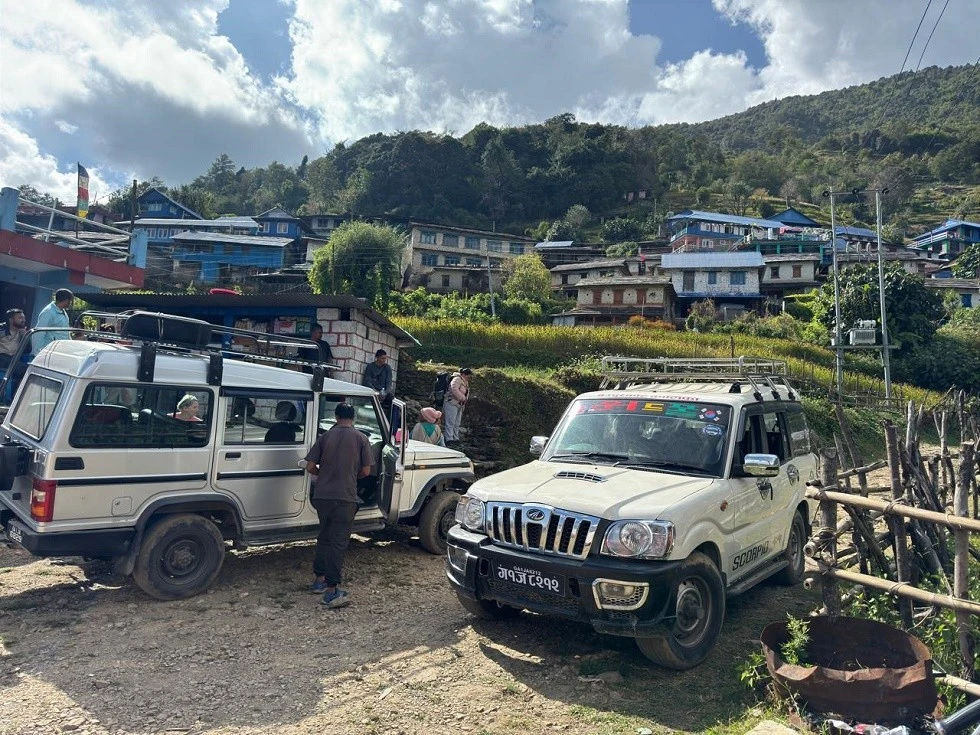
Our jeep transfers from Kathmandu to Salleri and Surke are arranged with drivers experienced specifically on this route, familiar with seasonal road conditions and the safest available detours when the primary road faces temporary closure due to weather or maintenance work.
Trekking leaders Bhim Tamang and Norbu Tamang coordinate the overnight stop in Salleri as a standard part of the itinerary rather than an optional extra, since pushing straight through to Surke in a single day isn’t considered a safe or comfortable option regardless of how motivated a group might be to save time on the schedule.
Vehicle standard and group size are confirmed before departure, ensuring trekkers know in advance whether they’re booked into a shared or private jeep and what that means for departure time, comfort, and total travel duration on both legs of the drive from Kathmandu.
Anyone weighing this route against the standard Lukla flight is welcome to compare both options directly with our team before booking, since the right choice depends heavily on individual schedule flexibility and how much of the trip’s appeal comes specifically from the overland journey itself rather than simply reaching Base Camp by the most direct path available.
Frequently Asked Questions Everest Base Camp Trek by Jeep
How much does the Everest Base Camp trek by jeep cost?
A shared jeep from Kathmandu to Salleri costs around USD 25 to 30 per person, while a private jeep for the same leg runs roughly USD 200 to 325. Continuing on to Surke adds an additional USD 25 to 50 per person for a shared seat, or USD 150 to 250 for a private vehicle.
What is the Everest Base Camp trek by jeep price for the full route?
The combined Kathmandu to Surke jeep journey typically costs USD 50 to 80 per person for a shared vehicle, or USD 400 to 475 for a private jeep covering both legs.
What is the Salleri to Lukla distance?
Salleri to Lukla covers roughly 38 to 43 kilometers combined, made up of a 35 to 40 kilometer jeep drive to Surke followed by approximately a one-hour walk to Lukla itself.
What is the Salleri to Phakding distance?
Salleri to Phakding covers approximately 55 to 60 kilometers combined, made up of a jeep drive to Surke followed by roughly two days of trekking via Paiya to reach Phakding.
What is the distance from Surke to Namche Bazaar?
Surke to Namche Bazaar covers approximately 29 to 31 kilometers, typically taking 2.5 to 3 days of trekking through Phakding before reaching Namche.
Is there a road from Surke to Lukla?
No continuous road currently connects Surke to Lukla; the connection is a walking trail covering approximately 3 kilometers, taking roughly one hour on foot.
How many kilometers do you walk on the Everest Base Camp trek by jeep?
Once the jeep portion ends at Surke, total walking distance to Base Camp and back runs close to 125 to 130 kilometers, closely matching the standard flight-based trekking distance.
How difficult is the Everest Base Camp trek by jeep compared to flying?
The trekking difficulty itself is nearly identical, since both routes join the same trail. The jeep route adds a physically tiring road journey before trekking begins, along with a slightly more gradual altitude introduction through extra low-elevation walking days.